



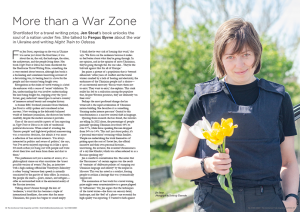
Shortlisted for a travel writing prize, Jen Stout’s book unlocks the soul of a nation under fire. She talked to Fergus Byrne about the war in Ukraine and writing Night Train to Odessa.
For Jen Stout, reporting on the war in Ukraine was never just about the front lines; it was about the air, the soil, the landscape, the cities, the architecture, and the people living there. Her book Night Train to Odessa has been shortlisted for the Sherborne Travel Writing Prize, something she is very excited about because, although her book is a fascinating and sometimes harrowing account of a devastating war, its beating heart is a love for the people and the country being fought over.
Recognition in the realm of travel writing is a label she embraces with a sense of ‘secret’ validation. To Jen, understanding this war involves understanding the land being fought for, stripping away the ‘post-Soviet, grey, industrial’
stereotypes to reveal a country of immense natural beauty and complex history.
A former BBC Scotland journalist from Shetland, Jen Stout is softly spoken and considered in her answers. Now working in the delicately balanced world of freelance journalism, she chooses her battles carefully, despite the modest income it provides.
One of the most notable aspects of her reporting in Night Train to Odessa is its lack of traditional political discussion. When asked if avoiding the ‘famous people’ and high-level political manoeuvring was a conscious decision, she admits it was more a reflection of her natural interests. ‘I’m always interested in politics and aware of politics,’ she says, ‘but I’ve never enjoyed reporting on it like a sport. I’d much rather just hang out with people and write about their lives and learn from them and chat to them.’
This preference isn’t just a matter of access; it’s a philosophical stance on what constitutes the ‘truest possible version of events.’ For Jen, an interview with a high-ranking official like Volodymyr Zelenskyy is often ‘boring’ because their speech is naturally constricted by the gravity of their office. In contrast, the people she meets—poets, miners, and refugees—offer an unvarnished look at the existential reality of the Russian invasion.
Talking about Ukraine through the lens of ‘resilience,’ a word that has become a staple of international headlines, she notes that for many Ukrainians, this praise has begun to sound empty. ‘I think they’re very sick of hearing that word,’ she says. ‘We focus on the resilience because it makes us feel better about what they’re going through. In my opinion, and in the opinion of most Ukrainians, they’re going through this for our sake… They’re the bulwark against that for all of Europe.’
Jen paints a picture of a population that is ‘beyond exhausted.’ After years of conflict and the brutal winters marked by a lack of heating and electricity, the endurance of the Ukrainian people isn’t a choice—it’s an existential necessity. ‘Russia wants them not to exist. They want to exist,’ she explains. This stark reality has led to a realisation among the populace that, despite Western promises, they are ultimately ‘on their own.’
Perhaps the most profound change she has witnessed is the rapid acceleration of Ukrainian nation-building. She describes it as something ‘forming under intense pressure.’ Central to this transformation is a massive societal shift in language.
Quoting from research she has found, the statistics are telling. In 2022 alone, the percentage of people primarily speaking Ukrainian rose from 44% to over 57%, while those speaking Russian dropped from 34% to 14%. This isn’t just about policy; it’s a ‘personal excavation’ occurring within families. ‘People are undertaking the work themselves of picking apart the sort of Soviet lies, the official narrative and their own personal histories… uncovering, for instance, the essential Ukrainianness of a city like Kharkiv, which was often referred to as a Russian-speaking city.’
Jen is careful to contextualise this. She notes that the ‘Russianness’ of certain regions was the result of ‘centuries of deliberate policies of stamping out Ukrainian language and identity’ by the empire in Moscow. This war has acted as a catalyst, forcing people to reclaim a heritage that was systematically suppressed.
The nomination of her work for a travel writing prize might seem counterintuitive to a genre plagued by ‘influencers.’ Yet, Jen argues that the techniques of the travel writer—the focus on sensory detail, landscape, and the ‘feel’ of a place—are essential for high-quality war reporting. ‘I wanted to kick against the stereotype of Ukraine as being like a sort of post-Soviet, grey, industrial, war-torn… it’s so much more than that. It’s so rich and varied.’
A seasoned TV and Radio reporter, she recalls describing the mining landscapes of the Donbas to Scottish audiences by comparing the Donbas Terrykorny (Coal Heaps) to the ‘Shale Bings’ of West Lothian. By finding these frames of reference, she bridges the gap between the reader and the conflict, making the ‘other’ feel familiar.
For Jen, travel writing is about how the world ‘impresses itself upon the brain.’ Whether it’s the ‘natural beauty’ of crossing the Danube at dawn or the specific way the air feels in Kharkiv in May, these details provide the context that dry military facts cannot. They remind the reader what is actually at stake: not just a territory, but a home.
The life of a freelance reporter in a war zone is one of constant ethical navigation. Jen speaks candidly about the ‘sick’ feeling of ‘descending like vultures’ on people during the worst moments of their lives. She recounts a haunting memory of a young mother crossing into Romania: ‘I was kind of hanging over just like pointing a camera at people and taking a picture on the scariest day of their lives… she looked just desolate. There wasn’t time for me to try and find her and get her story… she’s just this unnamed person, and that feels wrong somehow.’
This feeling of intrusion is balanced by a commitment to ‘documentary evidence.’ She describes discovering the body of an elderly man left on the side of a road in an ‘idyllic’ village. Although she took photos she knew would never be published, the act served as a recognition of someone who had been ‘left out like that.’ Stopping to document him was a refusal to let a human being—‘someone’s granddad’—simply vanish into the landscape.
In the midst of ‘kinetic war,’ Jen finds that ‘normality’ is vital. In Kyiv, this might manifest as a stubborn refusal to leave despite drone swarms, or the vital importance of a ‘very nice cup of coffee’ paid for with contactless payment. ‘That tiny slice of normality is like a desperate psychological need, and you will create it against perhaps the best idea… these little bits of civilised life are hugely important to people.’
She notes the surreal contrast of frontline cities like Kramatorsk, where, until recently, trains still ran and supermarkets were better stocked than those in the UK. However, the nature of the danger is changing. The rise of First Person View (FPV) drones—where a human being ‘hunts you through the streets’—has introduced a level of terror that artillery cannot rival. She highlights the killing of two journalists at a petrol station in Kramatorsk when a Russian Lancet kamikaze drone, designed for precision strikes, is reported to have directly targeted them.
Jen Stout’s relationship with Russia is one of profound ‘disillusionment,’ echoing the title of a book My Disillusionment in Russia by Russian-born anarchist and revolutionary Emma Goldman. Having studied the language and lived there before the full-scale invasion, Jen now refuses to set foot in the country. ‘I’d rather be under fire in Donbas than spend a second in Russia… The sense that you couldn’t really trust people, the sense that you might be listened in on… I find that more difficult to deal with than kinetic war.’
Her critique of Russia is not just political but moral and historical. She views the current conflict as part of a ‘long context’ of colonialism. This perspective allows her to see the war not as a sudden flare-up, but as the latest chapter in a centuries-old struggle for Ukrainian agency.
Despite the gravity of her work, Jen Stout remains grounded, even self-deprecating. Once referred to as ‘brave’ by one of those living under fire, she scoffs at the label, suggesting that real bravery is the ‘long slog’ of a mother working a job she hates to support her children. For her, reporting was a choice—a ‘wildly selfish’ desire to be in the thick of history.
As she prepares to speak at Sherborne Travel Writing Festival she tries to figure out her next move, her focus remains on the ‘human’ element of the story. Whether she is discussing the black humour that arises in air-raid shelters or the specific history of a single building in Kharkiv, her goal is to make the situation ‘be alive.’
It is a rare feat for a book about a contemporary war to be nominated for a travel writing prize, yet for Night Train to Odessa, it feels entirely appropriate. She uses the street names of Lviv and the Constructivist architecture of Kharkiv to tell a story of a country that is ‘rich and varied,’ rather than just ‘war-torn.’
While war will always require support to respond in kind, Jen Stout’s reporting also emphasises the importance of studying the maps of the people—their languages, their coffee shops, their memories, and their stubborn, beautiful refusal to vanish in order to help us better understand why that support must be maintained.
Jen Stout is scheduled to speak at the Sherborne Travel Writing Festival on Sunday 12th of April at 1 pm. For tickets visit www.sherbornetravelwritingfestival.com. Tickets can also be bought from Winstone’s Bookshop, Sherborne.
Night Train to Odessa by Jen Stout is published by Birlinn. ISBN: 9781846976476.