



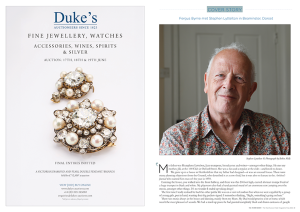
My father was Humphrey Lyttelton, Jazz trumpeter, broadcaster and writer—amongst other things. He met my mother, Jill, at the 100 Club in Oxford Street. She was a fan and a regular at the club—and loved to dance.
We grew up in a house in Hertfordshire that my father had designed—it was an unusual house. There were many planning objections from the Council, who described it as a cow shed, but it was also to feature in the Architect’s Journal who named him man of the year in 1959.
Entering the house, you walked into the front hallway, and there was this 20-foot high, curved abstract trompe l’oeil of a huge trumpet in black and white. My playroom also had a hand-painted mural of an enormous cow jumping over the moon, amongst other things. It’s no wonder I ended up taking drugs!
The first time I really realised he had this other public life was on a visit to London Zoo when we were engulfed by a group of young girls, pen in hand, wanting their fag packets signed. I remember thinking, “Right, something’s going on here.”
There was music always in the house and dancing, mainly from my Mum. My Dad would practise a lot at home, which wasn’t the most pleasant of sounds. We had a stand-up piano he had painted completely black and drawn cartoons of people dancing with “Yanks go home,” written in it. The first record my father ever played to me was Black, Brown and White by Big Bill Broonzy. Radio played a huge part in my appreciation of music. I would listen incessantly to Johnny Walker and John Peel absorbing everything—I loved their passion for all music.
The Lyttelton family has a very long history of going to Eton. This was not something my father wanted for us, and I have a sneaking pride that I was the first Lyttelton in generations not to be sent there.
Instead, I went to King Alfred School in Hampstead. It was a “progressive school” back then. My dad would joke he was always “waiting for the progress.” It was a very free school. No uniform, long hair and we called the teachers by their first names.
Many children of celebrities ended up being sent there. In my form I sat with one half of the Goons on either side of me. My fondest memory is of being the captain of the first eleven football team which was unbeaten over two years—we were probably stoned most of the time. Long hair, unbelievably tight shorts.
I left school with no real plan.
After weeks of trawling the streets of Northwest London I walked into a record shop in Golders Green called Tape Revolution and spoke to the manager. I got a job as a sales assistant selling vinyl, then moving on to 8-tracks and cassettes. I loved absolutely every minute. I couldn’t believe I was being paid to recommend music to people.
Tape Revolution became Our Price Records and I moved through the ranks, running many different stores in and around London, rising to a senior role. I got held up at gunpoint in the summer of 1976. Three guys burst into the shop in Kensington, waving a gun, shouting, “Where’s the cash?” We’d just banked it, so there were only coins in the till. One guy asked, “What did you do that for?” and without thinking I replied, “I didn’t know you were coming.” I got a right kicking for that. Before I called the police, I asked my colleague, “Have you got any of those temple balls [hashish] on you?” He did, so we ran out, hid them, ran back, and then called the police.
Retail back then was less anodyne and there was a certain freedom. You had to react to changes in demand. When punk took off, we were allowed to be creative. I was working in the Tottenham Court Road branch. We decided the best way to sell all the 7-inch singles that were coming in was to knock down the counter and rebuild it so that the seven-inch singles were right at the front. In a way you felt connected to the creative process.
Addiction thrives on secrecy. I had started taking heroin in my early 20s. I went from being in a senior position to a very dark place where moderation didn’t exist. I crashed the company car nine times. I lost my job, I lost the house, I lost the wife. I lost everything and caused untold pain and suffering to those I loved.
Jim Morrison has a line in Roadhouse Blues: “I’ve been down so goddamn long, it seems like up to me.” That is where addiction took me.
It took a long time and many efforts trying to stop. I was in and out of a detox centre in Kent with the best of intentions but not knowing how to stop. It was only when two guys, both two years clean, came and talked about how their lives had changed through the 12 Steps that I saw a chink of hope. Nick Cave describes hopefulness as an “adversarial,” hard-earned “warrior emotion” that actively defies cynicism and affirms the value of the world.
Not long after getting clean and moving back to London I met Emma in a Narcotics Anonymous meeting. I remember calling her from a halfway house and telling her, “I’ve just had this dream that we got married.” She went all ‘peculiar’ on the phone but a little more than eighteen months later, we got married.
I got back into working in record stores, this time with Tower Records, an American-owned family business. Tower Records was a very special place. There was a strong sense of community among the people who worked there, built around a shared passion for music. Buyers were not just buyers; they were music lovers. Our knowledge and enthusiasm translated directly to the people who came into the shop. One of the most common comments we heard was, “I only came in to buy one CD” or one LP, and they would walk out with a bag full.
I now serve as Chairman of the Board for Broadway Lodge, a residential rehab. We have an amazing caring team who treat the trauma of addiction alongside the 12 steps. There are always new drugs or addictive behaviours that can bring people to treatment. Currently, Ketamine, dressed up as a party drug, is destroying the lives of young people who face lifelong challenges as a result. Even what may seem as benign, the addictive use of mobile phones, specifically social media, is an area that we’re also having to pay attention to.
A central idea in recovery fellowships is the importance of carrying a simple message of hope: that an addict, any addict, can stop using, lose the desire to use, and find a new way to live. In many ways I see my involvement with Broadway Lodge as part of carrying that message forward.
There has been an inevitability of us finally landing in Dorset as it has woven its way throughout our lives. Although Emma and I spend most of our time here now, we still maintain a strong connection with London, where our four children all live. Like many of their generation they are hugely talented and capable, but they are also navigating a level of uncertainty that previous generations did not always face.
I never lost my passion for music, and I am finally piecing together my father’s vast body of work, including music publishing, written works, and illustrations. In between various other music projects, I hope to compile his rich legacy into a book.