



Christopher Roper highlights Horatio Morpurgo’s deep dive into Lyme’s hidden past.
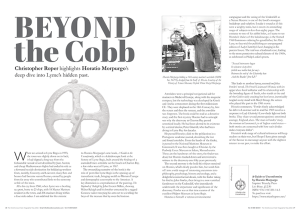
When we arrived in Lyme Regis in 1993, the town was slightly down on its luck; it had slipped a long way from the fashionable seaside resort described by Jane Austen; and cheap Mediterranean flights had ended its role as a favoured seaside destination for holidaying workers from, notably, Coventry and Leicester; many flats and houses had become second homes, owned by people from far away who contributed little to the economy or life of the town.
All a far cry from 1580, when Lyme was a bustling sea port, home to 23 ships, with 18 Master Mariners resident in the town, and 206 mariners living within a four mile radius. I am indebted for this statistic to Horatio Morpurgo’s new book, A Guide to the Unconformity, which is a kaleidoscopic look at the history of Lyme Regis, built around the finding of a corroded brass astrolabe on the beach in Charton Bay, a few miles west of Lyme, in 1967.
The overarching narrative of the book is the role of ports like Lyme Regis in the opening up of transatlantic trade, bringing wealth to Western Europe and demographic catastrophe to the Americas. A key illustration is a reproduction of the painting, The Boyhood of Raleigh by John Everett Millais, showing Walter Raleigh and his brother entranced by a ragged Genoese sailor sweeping his arm out to sea telling the boys of the treasure that lay over the horizon.
Astrolabes were a principal navigational aid for mariners in Medieval Europe, along with the magnetic compass, but the technology was developed by Greek and Arabic astronomers during the first millennium CE. They were displaced in the 18th Century by, first the octant and then the sextant, and the astrolabe was forgotten. The book could be read as a detective story; and the first mystery Horatio had to untangle was why the discovery in Charton Bay passed unnoticed locally. He had been alerted to its existence by a retired doctor, Peter Glanvill, who had been diving in Lyme Bay for decades.
He passed Horatio a link to the publication in a Portuguese academic journal, describing the lost and found astrolabe. From the hands of the finder, it passed to the National Maritime Museum in Greenwich; It was then bought at Christies by the Peabody Essex Museum in Salem, Massachusetts. These are the barebones of the story; the finder was dead, but Horatio tracked down and interviewed a witness to the discovery over fifty years previously.
The second mystery is the hold this object exercised on Horatio, which clearly puzzles him, but sends him off into a wide range of interesting excursions into philosophy, psychology, history and ecology, and a delightful counterfactual dream, with the finder taking his find to John Fowles, then living in a now vanished farmhouse on the Undercliff, who immediately understands the importance and significance of the discovery. Fowles was at that time curator of the excellent Philpot Museum in Lyme Regis.
Horatio is himself a veteran environmental campaigner and the saving of the Undercliff as a Nature Reserve is one of the book’s strongest backdrops and subplots. I make it sound as if this were a weighty tome, but it covers its astonishing range of subjects in less than eighty pages. The entrance to one of his rabbit holes, as I came to see Horatio’s shakes of the kaleidoscope, is the framed 1960 Summons ordering his grandfather, Sir Allen Lane, to face trial for publishing an unexpurgated edition of Lady Chatterley’s Lover, hanging in his parents house. The trial was a landmark case, leading to the more permissive cultural climate of the 1960s, as celebrated in Philip Larkin’s poem,
“Sexual intercourse began
In nineteen sixty-three
(which was rather late for me) –
Between the end of the Chatterley ban
And the Beatles’ first LP.”
This leads to another byway, centred on John Fowles’ novel, The French Lieutenant’s Woman, with its upper class fossil collector and his relationship with the brooding figure of Sarah, who stands at the end of the Cobb vainly awaiting her lost lover, inextricably tangled in my mind with Meryl Streep, the actress who played the part in the 1981 movie.
Horatio comments, “Fowles freely acknowledged his debt to Lawrence and to read his 1969 novel as a response to Lady Chatterley’s Lover sheds light on both books. They share several preoccupations: emotional courage, England, class. The man in Fowles’ story, the woman in Lawrence’s, is of higher social status—both stories are concerned with how such divides make everyone duller”.
Horatio’s wide range of cultural references will keep readers on their toes, but I hope I have given enough of the flavour to encourage anyone with the slightest interest in our past, to make the effort.