



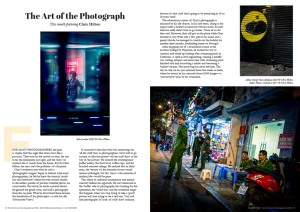
For many photographers, the goal is simple: find the angle that looks most like a postcard. They wait for the crowds to clear, the sun to hit the monument just right, and the ‘mess’ of modern life to vanish from the frame. But for Chris Hilton, the mess isn’t the problem—it’s the point.
Chris’s evolution into what he calls a ‘photographic magpie’ began in Iceland. Like many photographers, he felt he knew the country ‘inside out and backwards’ before he even arrived, thanks to the endless parade of pristine waterfall photos on social media. On arrival, he made a pivotal choice: he ignored the grand vistas and took a photograph from the car park. What he discovered there became the foundation of his philosophy—a style he calls ‘Obstructed Views.’
It occurred to him that what was interesting was ‘all the stuff that, as photographers, we’re told to go around, to take the picture—all the stuff that’s in the way of the picture.’ He noticed the contemporary puffer jackets, the throwaway coffee cups, and the brushed concrete railings. He realised that in thirty years, the ‘beauty’ of the Icelandic fissure would remain unchanged, but this ‘mess’—the minutiae of modern life—would be gone.
This blend of technical nonchalance and natural curiosity defines his approach. He isn’t interested in the ‘boffin’ side of photography, he’s hunting for the ephemeral, the ‘weird shit,’ and the accidental magic that happens when you stop trying to take a ‘good’ picture and start trying to see a real one. ‘I try and take photographs of loads of stuff that’s ordinary, because it’s that stuff that’s going to be interesting in 20 or 30 years’ time.’
The adventurous nature of Chris’s photography is mirrored by his life choices. In his late teens, sitting at the airport after a holiday in Morocco with his mates, he told them he really didn’t want to go home. ‘None of us do’ they said. However, they still got on the plane while Chris decided to stay. With only a few quid to his name and a penny whistle, he managed to stretch out the holiday for another three months, hitchhiking home via Portugal.
After dropping out of a foundation course at the London College of Furniture, he busked his way to America and ended up looking after swimming pools in California. A spell in civil engineering, running a landfill site, trading antiques and more time with swimming pools finished with him borrowing a ladder and becoming a window cleaner. The travel bug has never left him. The day we talk, he has just returned from five weeks in India, where he recons he has amassed about 8,000 images—a ‘conservative’ haul, by his estimation.
Although he was never obsessed with photography in his youth, he did possess what he called some ‘quite good photo albums.’ But his real journey into the heart of the photographic community started with a nudge from his wife. ‘She said, “You should really go to Bridport Camera Club.” I thought, I really don’t want to go… I just thought it would be full of tossers,’ he admits with characteristic candour.
Fifteen years later, he’s spent fourteen of them on the committee, helping to lead a quiet revolution. The club has shifted its focus from technical gear to ‘the bit that’s two inches behind the camera’—the human eye and the psychology of seeing. They withdrew from inter-club competitions to discourage copying and created a space where people are encouraged to be ‘comfortable with their own weird niche.’
‘It’s not technical at all now,’ Chris says. ‘It’s about seeing. It’s a really creative place.’
He cites the assistance of Bridport based photographer and writer Robert Golden as a big help on his photography learning curve. Compiling work to show to the Royal Photographic Society (RPS) for his associate membership, Robert pushed him to reshoot and refine images he had taken of lambing on a local farm. He presented the series to the RPS and also submitted the images to the Documentary Photographer of the Year competition at the same time. ‘I won the Documentary Photographer of the Year, amazing, and got completely rejected with the same photographs from my associateship,’ he laughs. ‘It made me realise really early on that it is really subjective, and you should take the wins and the losses with the same kind of pinch of salt.’
Chris describes himself as a ‘photographic magpie,’ collecting shiny bits of visual interest without always knowing why. Sometimes, these fragments coalesce into brilliant, unexpected narratives.
Take his Plastic Chairs of South East Asia project which became a book. It began when he noticed a recurring element in his favourite shots of Vietnam: the humble plastic chair. Inspired by Hokusai’s 36 Views of Mount Fuji, where the mountain serves as a distant anchor for disparate scenes, he used the chair to link the chaos of street life into a cohesive story. ‘The thing that linked them all was a plastic chair,’ he says.
Then there is the ‘accidental’ nature of his work. Because he often shoots from the hip or through the windows of moving vehicles, he frequently discovers the best part of the image only during the editing process.
‘I guess when you do that enough, weird stuff happens, because the world’s full of weird stuff,’ he notes. He recalls a photo of a bus where he didn’t even notice a chicken waiting at a zebra crossing until much later. On his recent India trip, he captured a scene of monkeys on a wall, only to realise later that the background featured a spray-painted sign for ‘Home Tutors’ and a phone number. ‘Often we don’t see because we don’t have time to process it,’ he muses.
Today, Chris Hilton is at a ‘tipping point.’ His reputation for valuing the ‘psychology of seeing’ over the mechanics of gear has allowed him to attract some of the biggest names in photography—like Paul Hill and Dayfdd Jones—to the Bridport Camera Club. For him, photography remains a visceral, rapid-fire pursuit. Whether he is underexposing night shots by four stops to catch the ‘soul’ of a city or hunting for monkeys and home tutors in the streets of India, he is consistently chasing the ephemeral. ‘Clothes, haircuts, habits, colours, fonts, street furniture—everything that constitutes the ‘mess’ is in constant flux,’ he explains. He views these ephemeral details as a form of ‘nostalgia before it’s become nostalgic.’ A discarded beer bottle top next to street food in Ho Chi Minh City or a modern extension lead snaking out of a window in a Moroccan barber shop are the true markers of time. They are the details we ignore today but will ache for in thirty years when they have inevitably vanished.
‘If I look at something twice, then it’s worth taking a photograph, even if I don’t know why,’ he concludes. ‘I only know why years later.’ In the world of Chris Hilton, the ‘mess’ isn’t something to be cropped out—it’s the very thing that makes the moment worth keeping.
To see more of Chris Hilton’s work and writing visit: https://www.visuallycuriousphotography.com/