



I grew up in a 1960s suburb which was the epitome of then-current suburban values. It was a close, a cul-de-sac, where the houses faced each other, so everyone could see what everyone else was doing, which created in that lower-middle-class and aspiring community an unspoken but real pressure: to conform, not least in the matter of the upkeep of gardens. Lawns were to be mown; hedges were to be trimmed; borders were to be weeded. Regularly. Neatness was all. And none of the fifteen households, in my time growing up in Norbury Close, ever transgressed these unwritten rules.
This attitude was one I absorbed: inside me still is a suburban garden-snob. Even today, I look at an overgrown lawn and instinctively think, mow the bloody thing! It has stayed with me all my life, and its grip only began to loosen about fifteen years ago when a very wise environmental figure pointed out to me: Nature doesn’t do neat. Nature likes scruffy.
I have come to see the wisdom of this. I know that an untrimmed hedge holds more wildlife than a trimmed one. Yet old prejudices die hard, and when Jo my wife, who runs our garden, insists on no-mow-May, an involuntary shiver still runs down my spine. And when she decided, three years ago, that half our garden was to be rewilded, I nearly had an attack of the vapours.
For I support rewilding, the idea that we should not just try to hold onto the wildlife we have, but also restore the wildlife we’ve lost—on the grand scale, that is. I strongly support the idea of turning whole landscapes, usually farmed intensively, back into something wilder and richer. I have seen what a wonderful success in can be in places like the Knepp estate in Sussex (and indeed in what is becoming a Knepp of the West, the Mapperton estate near Beaminster.) But Jo wasn’t thinking of anything Knepp-style glamorous, like sending in wild Highland cattle to graze our plot. She wanted rewilding on the small scale. She just wanted to leave it alone.
It’s the site of three horrible garages at the back of the garden which we had pulled down, and their concrete base removed, exposing the greensand underneath. And while my instinct was to have this rough bare patch laid to lawn, with new topsoil, Jo wanted to leave it entirely to its own devices, and just see what happened.
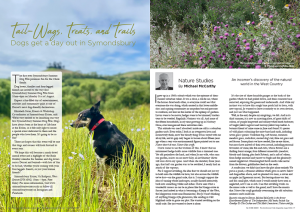
Well, in the end, despite my misgivings, we did. And in its third summer, it is now an arresting place, of great drifts of colour, of purple knapweed and creamy-white heath bedstraw, of bright yellow ragwort and browny-yellow hop trefoil. A botanist friend of mine came in June and found 31 species of wild plants colonising the once-bare hard earth, including seven grass species: Yorkshire fog, soft brome, common meadow grass, cocksfoot, crested dog’s tail, false oat grass and red fescue. Some plants we have seeded, like ox-eye daises, but most have arrived of their own accord, including personal favourites of mine, like fox-and-cubs, whose flowers are a thrilling burnt orange; four different cranesbills (meadow, bloody and shining, plus herb Robert); and a raft of others, from hedge mustard and yarrow to bugle and the gloriously-named nipplewort. Hummingbird hawk moths take nectar from the flowers; goldfinches feed on the seeds.
A confession: we didn’t just leave the plot alone entirely. We put in a pond, a dynamic addition which gives us newts below and dragonflies above, and we planted two trees, a rowan and an apple (an Egremont russet). But leaving-alone was key; and this small plot, which once I would merely have seen as neglected, now I see as rich. I see that rewilding works on the minor scale as well as the grand; and I have the mantra that Nature likes scruffy gradually overcoming the old suburban neatness-snob inside me.