



Looking back with unsparing honesty, Margaret Drabble talks to Lucy Brazier about career juggles, personal tragedy, and the memoirs she will only publish posthumously.
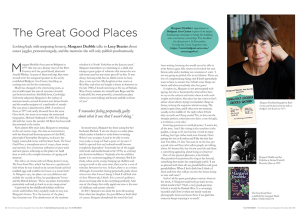
Margaret Drabble first came to Bridport in 1977. She was on a literary tour of the West Country with her good friend, dramatist Arnold Wesker. As part of their road trip, they were invited to be the inaugural speakers at the newly established Bridport Arts Centre, heralding an exciting new era for the community.
Much has changed in the intervening years, as you would expect for one of our most revered and beloved novelists. Sheffield born, Cambridge University educated, Margaret is the author of nineteen novels, around fourteen non-fiction books and the worthy recipient of a multitude of awards. She was given a damehood in 2008. A mother of three in 1977 and newly divorced from the actor Clive Swift, she went on to marry the renowned biographer, Michael Holdroyd in 1982. The lifelong rift with her sister, the novelist AS Byatt has been well documented in the media.
Now, almost fifty years later, Margaret is returning to the arts centre stage, this time in conversation with her friend and honorary patron of the BAC, playwright Christopher Hampton, to discuss her hugely successful career and her latest book, The Great Good Places, a triumphant mix of essays, short stories and memoir. It is a luminous collection of past work and new pieces, reflecting on the places we hold dear as well as the complex business of ageing and memory.
The title is an ‘ironic echo of Henry James’s story, The Great Good Place, which for him was a gentleman’s club where he was waited on by unseen hands and fed coddled eggs and could lie for hours in a warm bath.’ As Margaret says, her places are very different and include the seaside at Filey, her grandparents’ house and the British Library. ‘These are places I remember particularly well and go back to in my imagination.’
Captivated by her childhood holidays with her sisters and brother, Filey regularly made its way into Margaret’s fiction. ‘It is the eternity of the place that fascinates me. The timelessness of the seashore whether it is North Yorkshire or the Jurassic coast.’ Margaret remembers sea swimming as a child and taking in great gulps of saltwater that meant she was sick every year but was never put off by this. ‘It was always freezing cold, but we didn’t notice in those days, it was just fun. My daughter-in-law swims at West Bay and when we bought a house in Somerset in the late 1980s, I loved swimming in the sea at Porlock Weir. Every summer we visited Lyme Regis and the Undercliff, the most powerful, extraordinary place where you start walking and beauty unfolds in front of you.’
In recent years, Margaret has been caring for her husband, Michael. ‘I am not always in a calm place which makes it harder to settle down to writing. When I was younger, I used to be able to write very easily, as long as I had a space of my own. I hadn’t expected that my husband would become completely dependent.’ It reminds her of the juggle with work and motherhood in the 1970s, as a literary pre-feminist trailblazer. ‘Anybody who has children knows it is a constant juggling of attention. But I do think, when you’re young, bringing up children and trying to work at the same time, there can be a sort of stimulus between the two. At least, there is as a writer. Although, I remember feeling perpetually guilty about what it was that I wasn’t doing. I think I still feel a bit of that. Women do, I think. It is a sort of guiltiness about not being able to do everything perfectly. And one of the things that really appals me now is the cost of childcare and nursery schools.’
In 2017, Margaret was dealt the most devastating blow when her daughter, the poet Rebecca Swift died of cancer. Margaret abandoned the novel she had been writing, knowing she would never be able to write fiction again. She returns to her desk for non-fiction only and is working on a memoir of sorts. ‘I am not going to publish this in my lifetime. There are lots of compromising things that I don’t particularly want to have to answer for. I think some things are better said when everybody alive has gone.’
At eighty-six, Margaret is not preoccupied with ageing, but she is fascinated by what others have to say on the subject and writes about it with such insight and wisdom. She takes her late sister-in-law’s advice about always trying to remember things in threes, to keep the cognitive wheels turning. ‘My mind is quite clear, and I often test my memory, usually in the middle of the night when I think why on earth am I lying awake? Yet, in that circular thought process, sometimes you have a new thought, a revelation, a new idea.’
From big questions to small pleasures. ‘I read a lot, all the time. And I like sitting in the sunshine in the garden, as long as it’s not too hot. I used to enjoy walking, but I get rather tired now. Instead, I love getting the bus in London and I like the fact that now I’m older, it’s free. You can sit on the bus, get a good view and hear what other people are talking about. It’s human life, but it’s not your life and there is something appealing about being an observer.’
One of her greatest pleasures, is her family. Her grandson has promised to sing at her funeral, something that makes her surprisingly joyful. ‘I am so pleased with them all, my grandchildren and great grandchildren. When I feel a little low, I think of them and how they will go on into the future, being so nice and sweet.’
And of all the great good places written about in the book, if Margaret could only go back to one, which would it be? ‘That’s a very good question. I think it would be Porlock Weir. It is amazingly beautiful and I love it when my family send me photographs from our house there. I am glad that everyone keeps enjoying it so much.’