



Author Beth Gardiner speaks with Fergus Byrne about corporate spin, un-regulated chemicals, and redirecting public frustration toward the source.
As I write this, I am surrounded by plastic. It’s in the keyboard, the computer screen, the chair I sit on, the lenses in my glasses, and even the clothes I wear. Ubiquitous seems a feeble description of how much it invades our lives. But what I hadn’t really taken into account is the amount of plastic that has invaded our bodies, possibly even our brains.
Chatting with Beth Gardiner about her book Plastic Inc., I am more than disconcerted by some of the statistics she highlights. She points to recent studies showing that human brain tissue contains high levels of microplastics and nanoplastics, with a 2024 study published in Nature Medicine finding what researchers describe as an amount roughly equal to the mass of a standard plastic spoon.
If an amount of plastic the size of a disposable spoon has been polluting our brains, what will the chemicals in that have done to our cognitive development?
When we think about plastic pollution, our mental images are of ocean turtles entangled in plastic rings, rubbish strewn across beaches, and mounds of garbage buried in massive dump sites in faraway countries. It’s never a comfortable thought. Beth Gardiner describes it as ‘an inescapable, physical reminder of a frightening global mess—one we feel complicit in, yet powerless to change.’
However, in Plastic Inc., she reveals a narrative that few have touched on—one that moves beyond individual guilt and exposes single-use plastic as an engineered corporate strategy driven by fossil-fuel and petrochemical giants.
She argues that corporations like ExxonMobil, Shell, and Saudi Aramco realised early on that ‘pushing ever more plastic into our lives would bring fat profits.’ To maintain continuous demand, the industry invented the lucrative concept of single-use disposability, replacing reusable glass and metal with throwaway packaging.
Far from being a book about the frightening statistics on the damage caused by waste plastic products to our planet, the summary of Plastic Inc. is that big oil needs a new profit centre as we wean ourselves off fossil fuels for transport. Through relentless and thorough research, Beth shows that the industry has been and continues to invest massively in the production of plastics, in the belief that the developing world will become a big market for plastic-based products as it becomes more ‘developed’.
Beyond environmental litter, the book addresses the profound health consequences of pervasive plastic exposure. Beth details how thousands of additives—plasticisers, flame retardants, and stabilisers—enter our food supply, air, and bodies.
With rising incidence rates of neurocognitive conditions and early-onset cancers, Beth believes the lack of regulatory oversight presents an urgent public health crisis. She points to the health impacts on all of us who use plastics holding our food and our drinks: ‘and we’re wearing it, and we’re breathing it in.’ She cites the ‘complete failure of regulation of these chemicals… you’re talking about just thousands and thousands and thousands of chemicals. It’s impossible for the regulators to keep up.’
According to Beth, industry ‘spin’ has long perpetuated a narrative that blames the public for waste rather than overproduction—often of products as useless as a plastic cap to contain ‘drips’ from ice cream cones. The industry boasts about ‘recycling’, yet only 9% of plastic is recycled, and in many cases the claim that items are recyclable is simply not true.
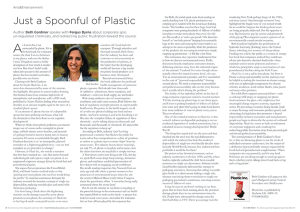
A New Jersey native now living in the UK, the day we speak Beth wears drop hoop earrings, distinctive glasses and combines a polished presentation of her subject with an engaging, casual confidence. She recalls reading magazines like Newsweek from an early age and talks about a pivotal moment in her awareness of environmental issues when she saw the scientist Michael Mann testify before Congress about the greenhouse effect. ‘I remember being really concerned about the ozone layer.’
But it’s not the statistics of our limits to recycling or the potential damage to the environment and our health that inspired Beth to work on this book—a project that took her nearly seven years—but rather the realisation that we have all been played by this corporate line.
For Beth, the initial spark came from reading an article detailing how U.S. plastic production was ramping up in tandem with the natural gas fracking boom. ‘The headline was that these huge fossil fuel companies were putting hundreds of billions of dollars into plans to make more plastic than ever,’ she tells me. She recalls it as ‘such a gut punch.’ She describes herself as ‘one little person’ bringing her sustainable bags to the store and carrying her water bottle in an attempt to be more responsible, while the producers of the products she was trying to avoid were simply ramping up production—it felt like a low blow.
This realisation also exposed a fundamental flaw in how we discuss environmental issues. Public discussion heavily emphasises consumer choices, deflecting attention away from the industrial origins of the material. ‘I realised I’ve never thought about actually where this material comes from’, she says. ‘I’m an environmental journalist, and I’ve succumbed to this sort of “personal responsibility” framing around plastic. We need a corporate responsibility and political accountability take on this story because that’s actually what’s driving the problem.’
The futility of her individual efforts in the face of mega-corporate expansion created a visceral reaction: ‘I’m like washing my plastic bags to use them again, and Exxon is putting hundreds of billions of dollars into some new plant that’s going to make God knows how many millions of tons of plastic every year in Texas or whatever.’
One of the central revelations in Plastic Inc. is that society’s reliance on disposable packaging is not an accidental byproduct of modern convenience, but a calculated business strategy developed after World War II.
‘The thing that stayed with me the most and that shocked me the most was the real deliberateness with which the industry has built this model of disposability of single-use over literally decades since basically World War II, because they understood how profitable it would be for them.’
She points to key historical moments, such as industry conferences in the late 1950s and 60s, where leaders explicitly outlined the shift from reusable containers to single-use alternatives. Industry insider Lloyd Stoffer famously delivered this strategy to packaging executives, observing that selling a reusable glass bottle to a client meant making a single sale, whereas convincing them to transition to single-use packaging guaranteed a continuous, recurring revenue stream of billions of units.
It may be easy to say there’s nothing to see here, given that we have been warning about the potential damage plastic does to our environment since the 60s. People have advocated for change since the first Earth Day in 1970. There was outrage over the wandering New York garbage barge of the 1980s, and more recent ‘Attenborough moments’ have highlighted the fragile state of our natural world. So we could be forgiven for thinking these issues are being properly addressed. But the opposite is true. Big businesses pay lip service and greenwash while paying PR companies to paint a picture of an environmentally sound circular economy.
Beth Gardiner highlights the proliferation of hydraulic fracturing (fracking) across the United States, unlocking vast reserves of cheap ethane. Fracking was sold to the public as a source of energy but fossil fuel companies realised they could turn ethane into lucrative chemical feedstocks—base materials used to create polymers and resins—which has prompted a surge in construction of new petrochemical facilities along the Gulf Coast.
Plastic Inc. is not a call to ban plastic. Far from it. Plastic is cheap and incredibly useful, and may even be helpful in making the transition to cleaner energy, with uses in lightweight components for electric vehicles, insulation, wind turbine blades, solar panels and many other products. But while Beth supports personal efforts—such as utilising refill shops or swapping out plastic food containers for glass—she emphasises that meaningful change requires systemic, regulatory action. By pressuring consumer-facing brands (such as major beverage and consumer product giants) and advocating for legislation that promotes a shared responsibility between consumers and manufacturers, people can begin to dismantle the system of enforced disposability. Plastic Inc. serves as both an indictment of corporate negligence and a roadmap for redirecting public frustration away from personal guilt and toward political accountability.
The central premise of Beth Gardiner’s Plastic Inc. is that our drowning planet is not the result of individual consumer carelessness, but the output of a deliberate, hyper-profitable strategy engineered by fossil fuel and petrochemical conglomerates. ‘These companies are very powerful, and it’s very hard. Politicians are not doing enough to stand up against them, whether you’re talking about fossil fuels or big tech or big plastic.’
Beth Gardiner will appear at this year’s Bridport Literary Festival. For tickets visit: BridLit.com
Plastic Inc. is published by Hachette UK. ISBN-13: 9781800962521