



After that long sodden winter, wildflower time is with us once more, and I am looking forward to seeing again the beauties of hedgerow and meadow and riverbank and woodland. Living on the chalk as my wife and I do, we have orchids among our late spring and early summer highlights, and a few weeks ago I was shown a field three miles from our house which I was told—by knowledgeable individuals—holds eleven different orchid species.
That got me excited, and I was thinking of it as my wildflower project for this year, until I was recently sent an advance copy of an unusual new book. Its name is The Devil’s Garden and its subtitle, The world’s most sinister plants and fungi. The author is Peter Marren, one of our very best botanical writers, and its theme is all the plants and fungi that can harm us. You might assume people wouldn’t be interested in that, or indeed might find it repugnant, but I think you’d be wrong, for we have within us a deep fascination for entities that can do us no good, do we not—why d’you think Jaws was such a success?
I myself find the subject riveting. The Devil’s Garden might not feature a great white shark, but it nonetheless contains accounts of many hair-raising specimens from the plant and fungal worlds—stingers, stinkers, blisterers, prickers, irritaters, creators of the weirdest hallucinations if we ingest them, and especially poisoners, often deadly, from all over the world (with the poisoning symptoms described in gruesome detail). There’s not only poison ivy from America, there’s the awful manchineel from Mexico, and the dreadful stinging tree or gympie-gympie from Australia, and the dire strychnine tree of India, and the even worse suicide tree (that’s its name) from Madagascar, and many more.
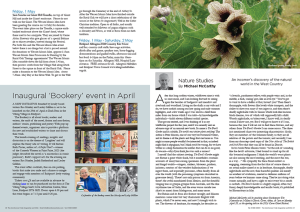
But Britain and its flora also feature strongly, and Marren mentions some toxic but very charismatic English wild plants, which I’ve never seen, and now I strongly wish to see. The flowers of henbane, for example, he describes as “a liverish, parchment yellow, with purple veins and, in the middle, a dark, staring spot, like an evil eye.” You’ve got to want to have a dekko at that, haven’t you? Then there’s thornapple, with flowers like lovely white trumpets, and the ability to drive you crazy if you ingest it, and then there’s deadly nightshade with its berries which look like luscious black cherries, two of which will supposedly kill a child. Woody nightshade, or bittersweet, I know well; its deadly cousin I know not, yet. But I will get to know it if I can, because this year I will set out to find these flowers, and any others from The Devil’s Garden I can come across. The three just mentioned share two interesting characteristics: firstly, they are members of the Solanum family, so they are all relatives of the potato and the tomato; and secondly, I see from my doorstep-sized copy of the New Atlas of The British and Irish Flora that they can all be found in Dorset.
In his book Peter Marren writes: “At the risk of sounding like the devil’s advocate, I feel bound to stand up for all this botanical malignancy. I think the world’s worst plants are also among the most exciting, and the most fun too, in a way…” His sympathy for these floral outlaws is engaging, stemming from the fact that of course there is no actual malice aimed at us in henbane, thornapple, deadly nightshade and the rest; their harmful qualities are merely an accident of evolution, created as defences millions of years before we humans came along. They’re just doing what comes naturally, and have a right to exist every bit as much as orchids. The Devil’s Garden is a highly original, often very funny, deeply knowledgeable and terrific book; it’s published by Bloomsbury in May.