



Joe Michell highlights some of the films showing at this year’s Bridport Film Festival
The approach of 2026’s Page To Screen Festival (Wednesday 22nd April – Sunday 26th April) presents Bridport an opportunity not just to watch a host of fantastic films, but also to relish in the rather singular experience of being immersed in a film in a room full of other people. This is what cinema is. It sounds obvious but its easy to forget in this era of ‘content’, where political speeches, cooking tutorials and movie clips rapidly succeed one another on tiny screens, that the theatrical experience (the huge screen, the dark room, other quiet spectators sat with you) is intrinsically tied to what cinema is.
2026 programmer Chris Chibnall and the rest of the curating team are clearly keenly aware of this. All the films selected, Chris points out, are ‘entirely different experiences on the big screen’.
Robin Baker, long-time head curator at the BFI National Archive and part of the Page to Screen Team, argues for the absorbing qualities of the cinema experience: ‘You are far more likely to become immersed in the world of the film. The scale of the image and the quality of the sound suck you into the director’s vision. When the lights go down you feed off the reactions of the people surrounding you’.
In his Oscar acceptance speech last year, Anora director Sean Baker pleaded with his filmmaking compatriots to “keep making films for the big screen”. Festivals like Bridport’s ‘Page to Screen’ play a part in keeping this art form alive.
This is just a small selection of this year’s films not to be missed…
The first evening gala screening of the festival will be John Schlesinger’s 1967 adaptation of Hardy’s Far From Madding Crowd (22nd, 6:30pm, BAC) which was filmed 60 years ago in locations surrounding Bridport. The film has a particular local appeal for this reason, but is astonishing in its own right. Julie Christie plays Bathsheba Everdene who inherits her uncle’s Dorset farm, and is forced to negotiate male suitors played by Peter Finch, Alan Bates and Terence Stamp. The story unfolds in familiar locations such as Maiden Castle, Shaftesbury’s Golden Hill, Abbotsbury, and Weymouth’s seafront—all sumptuously shot by Nicholas Roeg who would go on to become one of the great British auteurs.
Organisers of the festival are asking anybody involved with the filming in 1966 to come forward and attend the screening on Wednesday night.
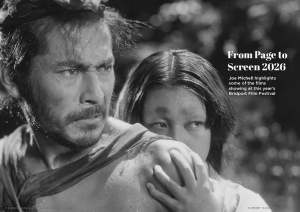
Thursday morning’s matinee (23rd, 10:45, BAC) will be Akira Kurosawa’s international breakthrough Rashomon (1950). It’s a film which expanded our understanding of truth and subjectivity in cinema and in its obfuscation of its central crime story, it plays as a philosophical treatise on these themes.
The film deals with a murder, the circumstances surrounding which are exhibited in four, often contradictory accounts; each one obscuring the last while filling in another piece of the puzzle.
Rashomon’s approach was so groundbreaking that its title entered legal parlance—the ‘Rashomon effect’ is referred to by lawyers in cases of antithetical testimonies.
If you are already familiar with the film’s ingenious narrative approach, it’s worth seeing again for the dazzling cinematography by Kazuo Miyagawa; the repeated motif of dappled sunlight filtered through the leaves, the roving camera nimbly tracing characters through the forest, and the arresting close ups of Toshiro Mifune, one of the greatest faces in all of cinema. Indeed, early English language reviews of the film (such as Catherine De La Roche’s for Sight and Sound) after the international premiere at Venice, focused only on its startling visual achievements as the Japanese film was screened with only Italian subtitles.
On Saturday evening, the gala showing (25th, 7:30pm, The Electric Palace) will be Stanley Kubrik’s 2001: A Space Odyssey (1968)—the ultimate science fiction film and arguably the purest realisation of Stanley Kubrick’s singular cinematic vision.
It’s a slow-moving “nonverbal experience” (Kubrick, 1968); gargantuan in ambition and scope and purely cinematic. If there was ever a film which demands to be seen (and heard) writ large, it’s ‘2001’. French/Argentine filmmaker and ‘2001’ devotee Gaspar Noé, believes “Kubrik’s films, and particularly 2001, don’t do well on small screens. You have to see 2001 on the big screen”.
Robin Baker argues: ‘The idea of watching 2001: A Space Odyssey—one of the festival’s highlights—on anything less than a cinema screen would rob you of the film’s greatest rewards. Like the astronauts in the film, you need to be immersed in the vastness and darkness of space’.
Kubrick’s film isn’t strictly an adaptation, but was instead written in tandem with Arthur C. Clarke after Kubrick wrote to him asking for a collaborator in creating ‘the proverbial “really good” science-fiction movie’. Despite its ties to the C. Clarke novel, ‘2001’ is an experiential film, the impact of which, written word couldn’t hope to impress. In it, Kubrick attempts to ‘directly [penetrate] the subconscious’, expressing his philosophical ‘message’ through the particular possibilities of the ‘medium’ (Kubrick, 1968). Attend the screening on Friday night and you’ll experience the grandeur of the docking ships, the quiet vacuum of sound in space, and the totally iconic and transcendent ‘stargate’ sequence developed by special affects pioneer Douglas Trumbull.
No doubt many people will have already seen Friday’s morning matinee: His Girl Friday (1940) directed by Howard Hawks (24th, 10:45am, BAC). It’s one of the most enduring of Hollywood’s golden age, yet it’s all too rare to be afforded the opportunity to see it in the company of others. It’s the kind of film you may have watched on TV on a Sunday afternoon but these classics really come to life with an audience. Famous for its rapid, witty dialogue and era defining central performances by Cary Grant and Rosalind Russel, His Girl Friday is a screwball romantic comedy set in the world of journalism in which a charismatic reporter tries to win back his wife’s affections through a farcical scheme.
Closing the festival on Sunday night (26th, 8pm, BAC) is another comedy: Buster Keaton’s 1926 silent classic The General, universally acknowledged as one of the greats, but perhaps (and this is true of all silent films) under-seen by general audiences due to misconceptions of silent cinema being an inaccessible, antiquated form. Rest assured, The General is every bit as thrilling and hilarious as any contemporary action comedy. This closing night gala will feature BFI Southbank house musician Steven Horne playing an accompanying score meaning you’ll get to enjoy the film in the most authentic way possible. In my experience, screenings like this one can be even more involving and memorable than typical modern screenings. The General is sure to be an unforgettable experience and I’d urge anyone who can attend the screening to do so.
Not only is 2026 the centenary of Keaton’s film, it will also mark one hundred years since the beautiful art deco theatre and Page to Screen venue The Electric Palace was built. It’s fascinating to consider that upon its opening, films would have been screened there in much the same way as The General will be screened for this festival. This remained the case until “talkies” took over in the 1930s and technology has of course become ever more sophisticated thereafter. In spite of this, live scores offer a resonance and presence which is hard to match and only serves to make the images on screen all the stronger.
While this summation has focused on the festival’s “classic” offerings, as a postscript: another obvious draw to the cinema is to see brand new releases. What better way to encounter the latest films on the programme than in the buzzy, exciting atmosphere of the festival? Look for Lynne Ramsay’s highly anticipated return Die My Love (24th, 2:15pm, BAC): a physical and visceral exploration of parenthood featuring a fierce, animalistic performance by Jennifer Lawrence, and another excellent turn from Robert Pattinson. Elsewhere Hafsia Herzi’s tender transnational coming of age feature The Little Sister screens on Saturday morning (25th, 10:45am, BAC), Park Chan Wook’s latest (Oldboy, The Handmaiden) No Other Choice, a serial killer comedy/thriller, is showing on Saturday afternoon (25th, 2:15pm, BAC), and fresh out of Cannes’ ‘Un Certain Regard’ is Thursday evening’s Pillion: a BDSM themed romantic comedy starring Alexander Skarsgaard! (23rd, 5pm, BAC). Another new film which must be mentioned is Gus Van Sant’s (Good Will Hunting, Elephant) latest, Dead Man’s Wire: a 70s set black-comedy thriller starring Bill Skasgard and Al Pacino (23rd, 8pm, BAC). This year’s contemporary offerings are vital and often challenging films. It’s a testament to Chris and the rest of the programming team to have chosen such a bold selection of new releases; they represent some of the best and most exciting films to release in recent years.
For a full list of films and special events at this year’s From Page to Screen Festival visit:
https://www.bridport-arts.com/fpts/