



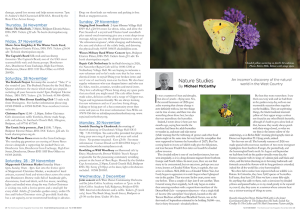
It was a summer of heat and drought, but also of jewels—flying ones. Yes, the record heatwaves of 2026 gave a dire warning that climate change is now definitely with us, but two things can be true at once, and there was also something about those hot, hot days that was marvellous: the butterflies.
Indeed, I wrote about it here just two months ago, saying how terrific the sunshine had been for adult butterflies to wander in, and mate and take nectar (while warning that the withering of grasses and other food plants might at the same time hit very hard the caterpillars that were supposed to become the butterflies of 2027). But I’m coming back to it now as I didn’t really give the full picture, not least because I hadn’t then taken on board the clouded yellow invasion.
The clouded yellow is one of our loveliest insects, but one seen irregularly, as it is a long-distance migrant from Southern Europe and North Africa. In most years, there are not that many to be encountered; but on occasions, perhaps one year in ten, known as Clouded Yellow Years, in capitals, they can arrive in millions. Well, 2026 was a Clouded Yellow Year, but I only began to appreciate it in mid-August when I glimpsed one in the garden. That was new. In five years, never seen one before. Then a couple of days later I saw another. Then I started seeing them regularly, but I only began to realise their amazing numbers with a report from members of the Dorset Bird Club—competent observers—that a single field of lucerne (the caterpillars’ food plant), located on the old Tarrant Rushton airfield near Blandford Forum, was in the first week of September estimated to be holding 30,000—yes, that is thirty thousand—clouded yellows.
By then they were everywhere. I saw them on every walk and we had them in the garden every day, with on one memorable occasion three together on the buddleia. They are captivating things, the black-bordered mustard-yellow of their upper wings a colour not found in any other British butterfly; although it’s hard to get a close look at that, because they nearly always perch with their wings closed, so what we see then is the lemon yellow of the underwings, as in Robin Mills’ stunning photograph, taken in Dorset on September 22. Flying jewels, indeed.
Yet that was not all. The butterfly summer of 2026 was made special with enormous numbers of two more immigrant lepidoptera from Southern Europe, the painted lady, and the hummingbird hawk moth. In August and September we had them both in the garden virtually every day, the former exquisite with its wings of salmon pink and black and white, and the latter charming in its hovering backwards and forwards around the flowers with its long proboscis extended, indeed for all the world like a tiny hummingbird.
We often fail to realise how impoverished our wildlife is in Britain. In Colombia, they have 3,642 species of butterflies. In France, they have 253. Here we have a mere fifty-eight. So anything that adds to them, such as invasions by clouded yellows and painted ladies, is to my mind greatly to be rejoiced in, even if, alas, they came in a summer whose extreme heat was a sinister warning of things to come.