



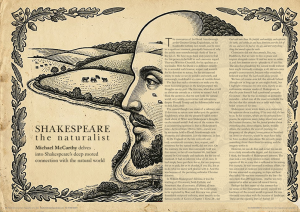
Michael McCarthy delves into Shakespeare’s deep-rooted connection with the natural world
The coronation of Sir David Attenborough as the Greatest Living Englishman, on his hundredth birthday last month, can be seen as a significant moment, principally because of why the public now overwhelmingly think of him as the G.L.E. We have to go back sixty years to find the last person to be held in such awesome regard. That was Winston Churchill, for his qualities as a war leader. With Sir David it is different entirely: he is accorded such honour, respect and warmth for his devotion to nature, for his unsurpassed ability to make us see its wonder and worth, and increasingly, to defend it at a time of terrible threat.
The fact that such a devotion can make you the most honoured person in the land prompted two thoughts on my part. The first was, what does it tell us about our attitude as a society to nature? And I think the answer is, that we now hold the natural world, very widely, in reverence and admiration, despite Donald Trump and his followers who want to drill, baby, drill!
The second thought was more of a sideways one. If devotion to nature now makes you the greatest Englishman, what did the greatest English writer think about it? What were Shakespeare’s thoughts on the natural world? And one of the reasons this is an interesting question is that in Shakespeare’s time—he lived from 1564 to 1616—nature was by no means held in David Attenborough-style reverence and admiration. Just the opposite, in fact.
In the England of the late sixteenth and early seventeenth centuries, love, respect, and reverence for the natural world, did not exist. On the contrary, the view then universally held was that nature, in fact all non-human life, had been created by God simply and explicitly for the use of mankind. It had no inherent value of its own. It had simply been put there for us, for our purposes; for us to grab, for us to plunder, if you like, for us to do what we damn well pleased with it. And this was because of the prevailing orthodox Christian doctrine.
In William Shakespeare’s lifetime, it was the teaching of Christianity, both Catholic and Protestant, that all creatures, all plants, all non-human life, had been created by the Lord simply to be exploited by Man; and this view was given formidable scriptural authority, most notably in the famous words of Genesis Chapter 1 Verse 28: And God said unto them, Be fruitful, and multiply, and replenish the earth, and subdue it: and have dominion over the fish of the sea, and over the fowl of the air, and over every living thing that moveth upon the earth.
Christianity did not then preach, like, say, Buddhism, that we were to live in peace and respect alongside nature. It said we were to subdue it, and have dominion over it—plunder it, if you like. The idea that plundering the natural world without limit might eventually endanger it all, did not enter people’s consciousness, because what everybody believed was that The Lord would always provide.
We have of course now left this attitude behind (though not as long ago as you might think), but I highlight it because my own view, merely as an enthusiastic amateur reader of Shakespeare, is that the poet himself had a profound sympathy for nature—that he was in essence an instinctive naturalist—which was all the more remarkable for the fact that this attitude was at odds with basic belief system of his time.
Shakespeare never wrote down, as a statement, his opinions about anything. If he ever did, it’s lost to us. In his sonnets, which are his personal love poems, he expresses many feelings about love and the human character, but his factual opinions about everything else, about religion, family, worldly affairs, the weather, the cost of printing, the frequency of the plague, house prices in Stratford on Avon or whatever, which he must have held, we have no direct idea about. We can only gauge something about them from his writing and the imagery within it.
However, we can do that, and in fact we can do it to a fairly considerable degree, and the reason is, I think, the breadth of Shakespeare’s interests. The man took a very lively interest in many different aspects of life in a way that is reflected in his writing. For example, he was interested in military affairs. He was interested in medicine (and indeed in poisons.) He was interested in sea-going, in ships and how they sailed. He was very interested in the law—he uses more than 200 legal terms. And he was very interested in what we now call natural history.
Perhaps the first aspect of this interest that we notice is that Shakespeare greatly enjoyed the loveliness of the natural world in general. He was obviously very taken with the beauties of landscape. These are the opening lines of Sonnet 33:
Full many a glorious morning have I seen
Flatter the mountain tops with sovereign eye,
Kissing with golden face the meadows green,
Gilding pale streams with heavenly alchemy…
It’s the start of a poem about his lover being like the sun, and how sad it is when the sun goes in. But in these lines he’s also talking about something specific—the landscape transformation that the slanting golden sunlight of early morning can bring about, in particular on rivers, with that exquisite fourth line (alchemy of course being the pseudo-science of turning base metals into gold, in which the Elizabethans and Jacobeans were so interested.)
I personally have seen this effect, as a fisherman on the chalk streams, and seeing small rivers turn briefly golden is an astonishing phenomenon. And the point is, what we have here is not a conventional, generalised description, it is a personal observation. It is something particular which the individual William Shakespeare has observed for himself—and rejoiced in.
Or let’s take this, the start of the long song which concludes the play Love’s Labour’s Lost:
When daisies pied and violets blue
And lady-smocks all silver-white
And cuckoo-buds of yellow hue
Do paint the meadows with delight…
which is referring to something we as a society have rediscovered in the last 20 to 30 years—the joy of species-rich wildflower meadows (97 per cent of which, we are so frequently told, we have lost in the last century.)
The song here refers to a mixture of daisies, violets and lady’s smock, but also cuckoo-buds, by which we’re pretty sure he means buttercups (the word buttercup itself not occurring anywhere in Shakespeare); and if you think about buttercups and the other flowers painting the meadows with delight, as he writes, you will know, if you have ever seen the meadows at Muker in Swaledale, say, at midsummer—completely golden!—or for that matter the Dorchester water meadows similarly brilliant in late May, that he is right on the button. And once again, this reflects a particular observation made by an individual man, William Shakespeare, who loved the wildflower meadows; does he not seem a naturalist at heart?
We can see a lot more of his nature-enthusiasm with his references to individual species of wildlife, although it has to be said, not so much from animals, meaning mammals and reptiles. Shakespeare has an obsession with animals, but only in a particular way—they are for him key descriptive symbols of human characteristics. So the lion is the king of beasts, and represents regal and majestic qualities, and a person can be noble as a lion—or for that matter, crafty as a fox, fierce as a bear, ravenous as a wolf, meek as a lamb, poisonous as a snake, lecherous as an ape, craven as the worst sort of dog. Shakespeare uses these animal epithets continually, in fact throughout his work he does it about 4,000 times, and in doing so he makes reference to roughly fifty species of mammals and perhaps another dozen reptiles and amphibians. They include all the domestic beasts: dogs, cats, horses, cattle, pigs, sheep and goats, and also many exotic animals he may very well never have seen—lions, certainly, but also tigers, leopards, elephants and crocodiles, as well as mythical beasts, such as unicorns, griffins, basilisks and dragons. But the point is this—he uses them symbolically. He doesn’t write about them ecologically. He’s not interested in their lives, in their natural habitats. So with Shakespeare’s animals, what you’re not going to get much of is any direct observation from nature, because he hasn’t observed a lion in the Warwickshire countryside, still less a unicorn or a dragon. When we turn to birds, though, the situation is different.
It’s clear that Shakespeare was interested in birds—he makes more than 600 mentions of birds, of about sixty species—and it’s also clear that he had real ecological knowledge of wild birds, the ones he saw in the countryside about him. For example, he refers to all seven species of the crow family in England: raven, [carrion] crow, rook, jay, jackdaw, magpie and chough. Shakespeare could tell the difference between a raven, a carrion crow and a rook, and by no means everyone can do that today. Although some of his references are taken from the popular culture of his time, such as the frequent use of the cuckoo as a symbol of the cuckold, the man who is cheated on by his wife, sometimes you do indeed get the sense with his birds of direct observation from nature. The aforesaid cuckoo provides a striking example. It comes in a reference by Shakespeare to one of the other species in whose nests the female cuckoo lays its own egg to be hatched out, the dunnock—which he calls, as indeed I did myself in my boyhood more than half a century ago, the hedge sparrow.
In King Lear, he has the Fool tell Lear about the predatory nature of his daughter Goneril, warning him:
The hedge-sparrow fed the cuckoo so long
That it had its head bit off by its young.
Shakespeare is here referring to the remarkable sight of a dunnock feeding a cuckoo chick which is so much bigger than its foster-parent that the dunnock’s head appears to disappear down the cuckoo chick’s throat; it might have seemed just a folk-saying to his original audience, but the actual phenomenon has now been photographed, and I think it’s perfectly possible that Shakespeare observed this himself, although we cannot know for sure.
However a very definite example of direct bird observation, and a very charming one, is to be found in Macbeth. When Duncan the King of Scotland arrives at Macbeth’s castle in Inverness—where that night Macbeth is to murder him—he remarks on how attractive it is. He says:
This castle hath a pleasant seat. The air
Nimbly and sweetly recommends itself
Unto our gentle senses.
And dramatically, that’s all that needs to be said. It’s a nice place. But Shakespeare doesn’t leave it there. Into the mouth of Banquo, one of Duncan’s noblemen, he then puts a dramatically quite unnecessary but very lovely invocation of the bird which is flying around the battlements:
This guest of summer The temple-haunting martlet, does approve
By his loved mansionry, that the heaven’s breath
Smells wooingly here. No jutty, frieze,
Buttress, nor coign of vantage, but this bird
Has made his pendant bed and procreant cradle.
Where they most breed and haunt, I have observed,
The air is delicate.
For “I have observed” read “William Shakespeare has observed.” This is direct personal observation by him, of the house martin, as beloved in my own Dorset village today, with its spring return from Africa keenly awaited, as it was in Warwickshire (or indeed in London) four hundred years ago. This is Shakespeare the naturalist speaking, loud and clear. But we find that we hear him speaking loudest of all when he’s dealing with plants.
Shakespeare refers to an astonishing number of plants—no fewer than 180 species, of trees, shrubs, bushes, fruits and vegetables as well of course as flowers, for which he clearly has a considerable knowledge, and a very deep affection. For example, he loves England’s spring wild flowers which have just had a stupendous season here in Dorset. Perhaps surprisingly, he never refers to snowdrops, but he does refer, and frequently, to daffodils, daisies, lady’s smock, primroses, cowslips, oxlips and violets, this last which he particularly likes, especially the sweet-smelling variety. We can add celandines and bluebells to that list. We don’t find the word celandine in Shakespeare, but he talks about marigolds which close when the sun goes in, and this is almost certainly a celandine reference. And similarly, though he never uses the word bluebell, he does use the word harebell and various authorities suggest that by harebell he means the bluebells which this year have flowered around us in such a stunning blue haze. He’s very fond of herbs and knows a lot about them; he never uses the word orchid but he has lots of references to lilies; and he’s exceptionally fond of roses—he refers to roses in his plays and poems 72 times.
We can illustrate very well his passion for flowers by looking at a famous short passage from A Midsummer Night’s Dream. The speaker is Oberon, king of the fairies, who has fallen out with his wife Titania, the fairy queen, and he’s going to play a trick on her—he’s going to have his fairy-servant Puck sprinkle a magical juice on Titania’s eyes while she’s asleep, which will make her fall in love with the first thing she sees when she wakes up, and what she wakes and sees in fact is a bloke with a donkey’s head, and it’s very funny. And Oberon describes to Puck where he can find Titania sleeping in the forest, and he says:
I know a bank where the wild thyme blows,
Where oxlips and the nodding violet grows,
Quite over-canopied with luscious woodbine,
With sweet musk-roses and with eglantine:
There sleeps Titania sometime of the night….
Once again here, as with the house martins, in terms of the plot we have something which is dramatically unnecessary. All Oberon needs to say is the first line, about the wild thyme, and give Puck directions. But Shakespeare carries on naming—as if he can’t stop himself—another five wild flowers that cover this bank: oxlips, violets, woodbine, which is honeysuckle, and two wild roses, the musk rose, Rosa moschata, and eglantine, which is the sweet briar rose, Rosa rubiginosa.
I do not think that many people today, except professional gardeners, could identify all six of those plants off the cuff—which gives you an indication of the uncommon nature of William Shakespeare’s wildflower expertise as well as his enthusiasm. You can see it on display again in another very famous passage, this one from Hamlet, spoken by Ophelia, who has gone mad because Hamlet her former lover has spurned her and (although accidentally) killed Polonius her father. And she comes into the court, in her madness, distributing flowers which have various symbolisms for her:
There’s rosemary, that’s for remembrance.
Pray you, love, remember. And there is pansies,
that’s for thoughts….
There’s fennel for you, and columbines.
There’s rue for you, and here’s some for me; we
may call it herb of grace o’ Sundays. You must wear
your rue with a difference. There’s a daisy. I would
give you some violets, but they withered all when
my father died. They say he made a good end.
And if we go past the sadness of the scene, and just look at it with a naturalist’s eye, we have a list of five more species, plus violets and daisies—rosemary, pansies, fennel, columbines, and rue. I don’t think many people could identify all those, either. And we can see Shakespeare’s botanical expertise even more vividly in The Winter’s Tale, where Perdita, the young princess, castaway as a baby and raised in a family of shepherds, is now acting as queen of the sheep shearing festival; and she’s giving out flowers to her guests:
Here’s flowers for you:Hot lavender, mints, savory, marjoram,
The marigold, that goes to bed wi’ th’ sun
And with him rises weeping…
Daffodils,
That come before the swallow dares, and take
The winds of March with beauty; violets dim,
But sweeter than the lids of Juno’s eyes
Or Cytherea’s breath; pale primroses,
That die unmarried ere they can behold
Bright Phoebus in his strength—a malady
Most incident to maids; bold oxlips and
The crown imperial; lilies of all kinds,
The flower-de-luce being one…
It’s a very beautiful passage, and if we count the species Perdita mentions, we have lavender, mint, savory, marjoram, marigold (which is probably celandine), daffodils, violets, primroses, oxlips, the crown imperial (an exotic flower which had come into England from the Middle East), and the fleur de luce, which is probably an iris—eleven more species that Shakespeare is familiar and comfortable with, and enjoys writing about. Talk about expertise…
It has been suggested that Shakespeare was a personal friend of John Gerard, who wrote the first botanical best-seller in English, his Herball, or Generall Historie of Plantes, which was published in 1597 when Shakespeare was 33. It has also been suggested that one of the four figures on the engraving which forms the frontispiece to the book, a handsome, moustachioed laurel-wreathed young man holding a fritillary flower, is Shakespeare himself, which if true would be the first authentic likeness of the poet before middle age. That is by no means certain, although there is evidence to support the claim… but it is indeed very likely that Shakespeare at least read and enjoyed Gerard’s Herball, and used it to deepen considerably his knowledge of the nature—“great creating nature,” he calls it, such an inspirational phrase—which he saw all around him as a boy from a small country town, and grew to love.
And yet he loved it in an age when the belief system of the world he lived in did nothing to encourage such love, which throws into sharp relief the remarkable and very personal character of his enthusiasm.
We shouldn’t exaggerate. It was by no means his principal theme. We cannot class Shakespeare as a nature poet, like Wordsworth, or poor John Clare who went mad, or Edward Thomas, say, who was killed in the First World War. But nature was vividly present in his writing as I have tried to show, and to a far greater extent than in the writings of his contemporaries such as Marlowe or Ben Johson, and probably more than in the work of most writers; and indeed some critics have suggested that Shakespeare anticipates or prefigures the Romantic poets like Wordsworth with their love for the wild life of the earth.
I think it’s worth realising this. Shakespeare is such a wonderful poetic artist and such a wonderful painter of human life, there is just so much of surpassing interest and delight in his 37 plays, five narrative poems, and 154 sonnets, that in the past his love for the natural world has to some extent perhaps been overlooked. But in an age when the natural world is so terribly threatened, an age where the qualification to be the Greatest Living Englishman is to love nature and defend it, let us be grateful for the fact that the greatest English writer loved it too, and were he alive today, would very likely be manning the barricades in its defence.
This is an edited version of a talk given at St Mary’s Church, Cerne Abbas, as part of the Cerne Giant Festival 2026.