



John Davis highlights Britain’s 1851 John Bull moment with The Great Exhibition
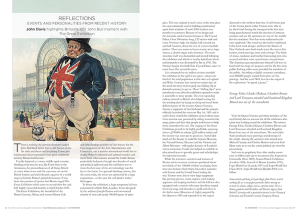
There is nothing the cartoon character named John Bull liked better than to lift his hat, shake his stick and thrust out his plump Union Jack waistcoated-chest to proclaim how great nineteenth century Britain had become.
Usually depicted as a stout, middle-aged, country-dwelling jovial man he was, like Uncle Sam to the Americans, the personification of all things British at a time when it was said the sun never set on the British Empire and red coloured a quarter of a world map to illustrate Britain’s global dominance. It was from this position of power that Britain staged The Great Exhibition which came to an end after five and half highly successful months in mid-October 1851.
The Great Exhibition, the brainchild of the Prince Consort, Albert, civil servant Henry Cole and other leading members of the Society for the Encouragement of the Arts, Manufactures and Commerce, was a massive international world fair to display Britain’s industrial and cultural wonders and those from other nations around the world. Britain particularly had gone through two decades of social and political upheaval and this exhibition was to show that her state-of-the-art technology was the key to the future. In a ground-breaking venture, but the norm today, the event was sponsored by a large corporation—in this case the soft drinks’ maker Schweppes.
To house the exhibition, a huge temporary hall was constructed in Hyde Park, London. It was designed by the architect Joseph Paxton and constructed entirely of iron and nearly 300,000 panes of plate glass. This was original in itself since at this time glass was not commonly used in building construction apart from windows. It took 2000 workers nine months to construct. Because of its design and the materials used it became known as The Crystal Palace. Over 500 metres long, 125 metres wide and some 30 metres high, the display hall covered ten and half hectares, about the size of sixteen football pitches. There was room to house mature trees, large statues, a church organ and a fountain. The main structure itself was dismantled and moved following the exhibition and rebuilt at nearby Sydenham where unfortunately it was destroyed by fire in 1936. The Premier League Football Club, Crystal Palace, takes its name from this second location.
It is estimated that six million visitors attended the exhibition in the spell it was open—about one third of the total population at that time in England and Wales. Entrance fees varied on certain days of the week but most visitors paid one shilling (5p in decimal currency) to get in. These “shilling days” were introduced soon after the exhibition opened to make it accessible to more people. The ever-expanding railway network in Britain also helped costing for the working class by laying on cheap rail travel from different parts of the country. Queen Victoria, forever a supporter of her husband and his projects, officially launched the event on May 1st, 1851 and is said to have visited the exhibition at least thirty times.
Extra revenue was generated by selling souvenirs like mugs, plates and fans that people took home to help them remember the visit. The staging of the Great Exhibition proved to be highly profitable, amassing almost £190,000 in takings (£20 million today) and the income was soon put to good use. It provided much of the finance to build the Science Museum, the Natural History Museum and the Victoria and Albert Museum—still regular features of London’s visitor attractions. Funds also helped to establish an educational trust to provide grants and scholarships for industrial research.
While the inventors, scientists and artisans of Britain and its overseas territories produced about two-thirds of the 100,000 exhibits on display, there were also features from thirty-four other countries with France and the United States leading the way. Visitors were able to view large equipment like printing presses, steam engines, steel making apparatus and reaping machines and the hall was also equipped with a massive telescope. Jewellery ranged from tiny rings and brooches in gold and silver to the Koh-i-noor (Mountain of Light) acquired by the Queen in 1849 and reputed to be the largest diamond in the world at that time. It still forms part of the Crown Jewels today. Visitors were able to try their hand forcing the strongest locks that were being manufactured, watch the creation of intricate ceramics and see the operation of one of the world’s first fax machines. Not that more traditional crafts were neglected. One stand was devoted to traditional Celtic knot-work designs and from the Maoris of New Zealand came hand-made items like woven flax baskets, wood carvings, mats and eel-traps.
The fields of music, medicine and weather forecasting were also covered and there were several more unusual items. The American gun manufacturer Samuel Colt was on hand with his range of weapons and for the first time public flushing toilets were provided for members of the public. According to highly numerate attendants, over 800,000 people availed themselves of this privilege. And the cost? Well, here lies the origin of the euphemism “to spend a penny.”
Visits by Queen Victoria and other members of the royal family did not account for all the celebrities who spent time looking round the exhibition. The writers George Eliot, Charles Dickens, Charlotte Bronte and Lord Tennyson attended and Isambard Kingdom Brunel was one of the consultants. The artist John Nash produced many paintings and drawings of the stands. Among the scientists who visited were Michael Faraday and Charles Darwin and even Karl Marx came in to run his astute political eye over the proceedings.
Such was its popularity that other similar events were to follow right up to the present day: Exposition Universelle (Paris 1889), Franco-British Exhibition (London 1908), Festival of Britain (London 1951), Expo World Fair (Canada 1967) and Expo World Fair China 2010). Expo World Fair (Riyadh 2030) is to follow.