



With an eye on gardens, John Davis remembers Gregor Mendel.
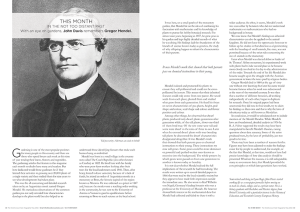
Gardening is one of the most popular pastimes for many people in this country and there are those who spend hours each week at this time of year tending their lawns, flowers and vegetables. The gardening articles that feature in this magazine each month no doubt have many avid readers. But how dedicated would those gardeners be if they limited their activities to growing over 20,000 plants of a single variety and then studied them for nine years to see what developments had taken place.
This was the all-consuming and detailed research taken on by an Augustinian monk named Gregor Mendel. His meticulous observations of the common garden pea not only revealed how characteristics develop in the plant world but also helped us to understand those identifying features that make each human being an individual.
Mendel was born in a small village in the country now called The Czech Republic (also often known as Czechia) in 1822. He lived here with his family who were poor farm workers looking after fruit trees for the local landowners until 1841.
Then, after being forced to leave university because of a lack of funds, he joined an order of Augustinian monks in a monastery at Brno, the historic capital of the region known as Moravia. He was ordained as a priest in 1847 and, because the monks were a teaching order working in the community, he was sent to the University of Austria in Vienna to gain his qualifications before returning to Brno to teach science at the local school.
It was here, on a small patch of the monastery garden, that Mendel hit on the idea of combining his fascination with mathematics and his knowledge of plants to pursue his hobby-botanical research. For almost nine years, beginning in 1857, he grew peas in his garden and kept highly detailed records of what he was doing. His findings laid the foundations of the branch of science known today as genetics, the study of why offspring happen to inherit the characteristics of their parents.
Mendel isolated and protected his plants to ensure they self-pollinated and could not be cross-pollinated by insects. This meant that their inherited features could only come from one parent. He saved seeds from each plant, planted them and studied what grew from each generation. He fixed his focus on seven characteristics of pea plants, height, pod shape and colour, seed shape and colour and flower position and colour.
Among other things, he observed that dwarf plants produced only dwarf plants generation after generation while, of the tall plants, about one-third of them bred true. Of the rest some were tall and some were dwarf in the ratio of three to one. Later when he crossed dwarf plants with true-breeding tall plants he discovered the dwarf characteristics disappeared altogether. It was Mendel’s work that showed that both parents pass on chemical instructions to their young. These instructions we now call genes. Some genes could be more dominant or powerful and pushed weaker ones-known as recessive-into the background. The whole process by which genes were passed on from one generation to another is known today as heredity.
It is not clear whether Mendal realised the full implications of the research he had been doing. The results were written up in several detailed papers in 1866 that were read to the local scientific society but they appear to have made little impression outside the immediate area. He also wrote to Karl Wilhelm von Nageli, Germany’s leading botanist who was a professor at the University of Munich. He however showed little interest in the mathematical data that Mendel had collected and failed to share it with a wider audience. So often, it seems, Mendels’s work was seen either by botanists who did not understand mathematics or mathematicians who had no background in botany.
We now know that Mendel’s findings on inherited characteristics can also be applied to the animal kingdom. He did not have the opportunity however to follow up his studies in that direction as experimenting with the breeding of small animals, like mice, was not permitted because of the strict rules concerning the use of animals in the monastery.
Later when Mendel was elected abbot or leader of St. Thomas’ Abbey monastery, his experimental work with plants had to take second place as he became more closely involved in the day-to-day administration of the order. Towards the end of his life Mendel also became caught up in the struggle with the Austrian government to lower the taxes paid by religious bodies.
Gregor Mendel died in 1884 at the age of sixty-one without ever knowing that later his name would become famous when his work was rediscovered at the start of the twentieth century. It was then that a number of different botanists, all working independently of each other, began to duplicate his research. Once his original papers had been uncovered, they did not, to their credit, try to claim his findings as their own and that is why the laws of inheritance today as still known as Mendelian.
In conclusion, it would be unbalanced not to include mention of the Mendel Paradox. While Mendel’s laws are foundational, detailed analysis in 1936 by R. A. Fisher suggested the results may have been manipulated to benefit Mendel’s theories, raising questions about data accuracy. Some of the ratios produced were, by the laws of probability, just too good to be true.
There may have been a number of reasons for this. Figures may have been adjusted to make the findings easier for lay people to understand, for example, or the fact that Mendel, at that time, would not have had precise knowledge of how data analysis should be presented. Whatever the reasons, it is still indisputable, many re-assessments later, that Mendel provided the core principles on which later geneticists have worked.
Semi-retired and living in Lyme Regis, John Davis started working life as a newspaper journalist before moving on to teach in schools, colleges and as a private tutor. He is a history graduate with Bachelors and Masters degrees from Bristol University with a particular interest in the History of Education and Twentieth Century European History.