



In a groundbreaking new film, Derek vs Derek, two Devon farmers face off in a battle of practicality and ideals. By Fergus Byrne.
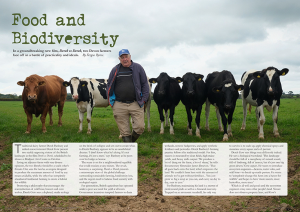
Traditional dairy farmer Derek Banbury and radical conservationist Derek Gow present two starkly opposing visions of the British landscape in the film Derek vs Derek, scheduled to be shown at Bridport Arts Centre in October.
Living on adjacent farms with very diverse opinions, the two Dereks should be at each other’s throats. One sees the land as an engine designed to produce the maximum amount of food by any means available, while the other has completely abandoned traditional farming to create a habitat for wildlife.
Promoting a philosophy that encourages the reintroduction of wild boar, beavers and even wolves, Derek Gow sees a depleted, sterile ecology on the brink of collapse and sets out to create what, to Derek Banbury, appears to be an uninhibited disaster. ‘I don’t know what he’s doing. It’s not farming, it’s just a mess.’ says Banbury as he peers over his hedge in horror.
The scene is set for a neighbourhood squabble that could escalate at any minute. The result, however, is surprising. Derek vs Derek presents a microscopic view of the global challenge surrounding sustainable farming, biodiversity loss, and the urgent need to balance food security with ecological repair.
For generations, British agriculture has operated under a post-war need for yield at all costs. Government incentives tempted farmers to drain wetlands, remove hedgerows, and apply synthetic fertilisers and pesticides. Derek Banbury’s farming practice follows this traditional model. For him, success is measured by clean fields, high maize yields, and heavy milk output: ‘We produce a lot of dung on the farm, a lot of slurry,’ he tells documentary filmmaker James Dawson. ‘That all goes back onto the land, which improves the land. We couldn’t farm here with the amount of animals we’ve got without fertiliser… You just grow as big a crop as you can, and carry on day to day, year to year.’
For Banbury, maintaining his land is a matter of professional pride as well as a financial necessity. Trapped on an economic treadmill, his only way to survive is to scale up, apply chemical sprays and maximise every square inch of pasture.
Derek Gow sees things very differently indeed. He sees a biological wasteland. ‘This landscape should be full of a cacophony of natural sound, full of birdsong, full of insects, but it’s just one big green desert,’ Gow argues. He wants to introduce ecosystem engineers—beavers, water voles, and wild boar—to break up sterile pasture. He wants to ‘completely change this farm into a haven for wildlife’ and hopes to have ‘more insects, more butterflies, more trees.’
Which is all well and good until the ecosystem engineers stray onto other people’s land. Nature does not observe property lines, and Gow’s radical methods quickly draw the ire of his farming neighbours. Escaped wild boar dig up neighbouring cornfields and are accused of preying on livestock. Beavers construct dams that drown carefully maintained agricultural drainage systems. When Gow bursts drainage pipes installed decades ago under government grants, local farmers view it as active sabotage of productive land.
Neighbourhood hostility reaches a boiling point over discussions about species reintroductions, such as wolves and free-roaming boar. Local sheep farmers express existential dread over stock losses, with one young farmer noting: ‘The last thing we want to see is a carcass in the field… Animals taking our stock that we put our life into.’ Gow remains undeterred by local hostility, admitting: ‘I never wanted to do any of this to win a fucking popularity contest.’
At times hilarious and at times moving, the film shines a light on the vital debate surrounding the future of rural Britain, encouraging conversations about how farming and nature restoration can work together. Yet, the film also exposes a genuine structural dilemma: how can individual farmers be expected to accommodate unpredictable wildlife when their livelihoods depend on thin profit margins driven by rigid market demands? As Gow himself acknowledges, agriculture is a high-stress, low-reward industry where ‘the subsidies barely enable them to carry on’ and economic pressures leave little room to think about nature.
The debate highlights the central paradox of modern land management. As Gow explains: ‘The paradox of modern farming is that yeah, it produces food in great abundance, but in creating this abundance, we’re destroying the fabric of nature.’ He says we will reach a point where we can’t add chemicals anymore and then ‘nothing will grow, and then the land really is truly finished.’
Seeing nature return on Gow’s land, Banbury is forced to look again at his own farm and reflect on what has happened over the 50 years since he was a boy. Now in his 70s, he thinks about the wildlife he once used to see, which is now absent, and the part played by farmers and government in unwittingly destroying the natural world to produce food.
Regardless of the farming discipline practised, Derek vs Derek ultimately shows that beneath the divide between farming and conservation there is a shared connection to the land. True sustainability requires both the hands that feed us and the wild natural systems that keep the planet alive.
Derek vs Derek is scheduled to be shown at Bridport Arts Centre on Thursday 22nd of October at 7:30pm. There will be a post film Q&A with Dr Sam Rose who leads the Brit Valley Landscape Recovery Project. For tickets, visit: https://www.bridport-arts.com/