



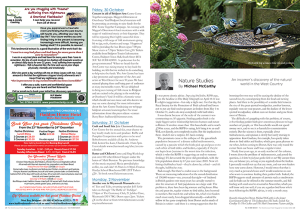
It was pretty drastic advice. Stop using bird feeders, RSPB urges, was the headline in The Daily Telegraph on April 10. It was a slight exaggeration—but only a slight one. For that day, the Royal Society for the Protection of Birds advised bird lovers not to put any bird seed or peanuts in feeders from May 1 to October 31, and to do away completely with bird tables.
It was drastic because of the scale of the custom it was commenting on. It’s gigantic. Feeding garden birds is the single biggest active relationship between humans and nature in Britain. It involves more than 12m households and is worth £350m a year, and the RSPB is saying, let’s bring it to an end? Well, not directly, not completely maybe. But the implication is there. And it’s not a surprise. It’s been coming.
The proximate cause is the collapse of the greenfinch population because of a disease called trichomonosis, caused by a parasite which the birds pick up and pass on to each other at bird tables and feeders, especially if they’re not kept clean (summer is the worst time for infection, which is why the RSPB is suggesting an end to summer feeding.) It’s devastated the poor old greenfinch, with the UK population down by 67 per cent since 2005. Now it’s hitting chaffinches hard—they’re down by a third—and it’s thought, bullfinches too.
Bad enough. But there’s a wider issue in the background. There are increasing indications that the annual distribution of 150,000 tonnes—yes, you read that right—of birdseed in British gardens over many years has actually started to alter the structure of bird populations on a large scale. The problem is, there have been big winners and big losers. Blue tits and great tits, regular visitors to bird tables, have boomed in numbers. But marsh tits and willow tits, which visit feeders much more rarely, have dropped dramatically—indeed the willow tit has gone completely from Dorset and in much of Britain is extinct—and there is a strong suggestion that the booming first two may well be causing the decline of the second two, by outcompeting them for food and nesting places. And there is the possibility of a similar link between the rise of the great spotted woodpecker, another boomer, regularly seen on your peanuts, and the decline of the lesser spotted woodpecker, seldom seen on feeders and gone from most of Britain.
The difficulty of grappling with this problem, of course, is that feeding garden birds gives enormous pleasure to huge numbers of people, or 12m households would not spend money on it, and to see it as harmful is counterintuitive entirely. But the science is there, especially about trichomonosis, and opinion is slowly but surely moving to opposition. Kew Gardens, for example, has quietly taken down its bird tables and feeders, which gave great pleasure to me when, before coming to Dorset, Kew was only round the corner from our house and I was a regular visitor.
Nearly four years ago, in an early number of this column, I wrote about the problem of trichomonosis, and posed the question, is it better to feed your garden birds or not? My answer then was, on balance yes, as long as you regularly clean the feeders. I personally would not say that any more, and our own feeders have now come down. However, I would stress that that is very much a personal choice and I would condemn no-one who wants to continue feeding their garden birds. Indeed, the RSPB suggests small amounts of protein such as mealworms and fat balls can be offered in the summer months, and full feeding with seeds can be resumed in November, which you will know only too well, if you are a garden bird lover who’s been following the RSPB’s advice, is only a month away.