



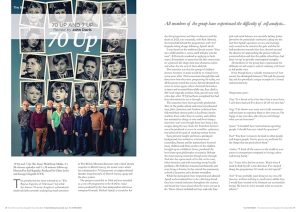
70 Up and 7 Up: The Story: MultiStory Media, 2 x 90 minutes episodes and 1 x 30 minutes follow up. Directed by Asif Kapadia; Produced by Claire Lewis and George Chignell; ITVX.
This production has been referred to as “The Bayeux Tapestry of Television” but while the famous 70 metres length of embroidered medieval cloth currently undergoing much attention in The British Museum illustrates only a brief distant snapshot in British history, the iconic series which has culminated in 70 Up presents an unprecedented decades-long chronicle of British society, aging and the class system.
The project started life in 1964 and was intended as a one-off programme in the World in Action series produced by the then independent television company Granada. Michael Apted, a researcher for the first programme and then its director until his death in 2023, was essentially, with Paul Almond, the brainchild behind the programmes with Asif Kapadia taking charge following Apted’s death.
It was based on the traditional Jesuit maxim “Give me a child until he is seven and I will give you the man”. (Effectively mankind so applying to both sexes.) It translates to mean that the first seven years of a person’s life shape their core character, habits and values for the rest of their adult life.
The intention was that the group of children chosen, fourteen in total, would be re-visited every seven years after 1964 to ascertain through film and discussion how they were progressing. In reality, not all the group stayed the course.
Several dropped out never to return again, others absented themselves at times and re-joined later while one, Lyn, died in 2013 and tragically another, Nick, passed away only a few days after 70 Up had been completed but had been determined to see it through.
The outcomes have been generally predictable. Two of the public school and university educated men, John (barrister) and Andrew (solicitor) have followed their chosen paths as has Bruce (maths teacher). East-ender Tony (ex-jockey and cabbie) has remained as chirpy as ever and loves being a television ‘star’ even though there have been a few scrapes along the way. Nick, the Yorkshire farmer’s son who predicted at seven he would be a physicist, had achieved his goal of studying nuclear fusion.
Suzy, privately taught and from a privileged background, has worked as a bereavement counsellor, Symon and his partner have fostered many children and Paul, another of the children brought up in a children’s home, produced the best home-spun philosophy on camera. Perhaps the most moving moments though came through Neil who has spent much of his life on his own, often homeless and with recurring mental health problems. His faith has remained unshakeable and now, living in France, he has served the community as both a lay pastor and a district councillor.
While the participants have respected and admired Apted and considered him to be a life-long friend, they have voiced criticisms throughout the journey and raised key issues about what the series set out to do. Those chosen included ten boys and only four girls and racial balance was certainly lacking. Jackie proved to be particularly combative calling out the fact that Apted’s questions on sex and marriage only seemed to be aimed at the girls and that he had tendencies towards class bias. Several accused the director of approaching the project with pre-conceived ideas and that the public-school boys had been ‘set up’ to provide stereotypical examples.
All members of the group have experienced the difficulty of self-analysis and of enduring a life lived in full public view.
It has though been a valuable microcosm of how society has developed between 1964 and the present day and has provided a unique example of a shared national memory.
Programme gems:
Tony: “It is better to be a has been than a never have. I ain’t done bad and I’ve done it all off my own bat.”
Suzy: “Life throws you some curve balls sometimes and you have to negotiate them as best you can. I’m happy in my own skin, after all you can’t change what you are born into.”
Symon: “I shouldn’t have worried about upsetting people. I should have just asked the questions.”
Paul: “You have to learn to be kind to other people and forgive people. You’ve got to try and look for the things that are good about them.”
Andrew: “I think all the success in the world in your career is unimportant compared to having a close and loving family.”
Sue: “I have felt a bit lost at times. That’s when I need to find myself a new direction. I’ve enjoyed doing the programmes. It’s made me feel special.”
Neil: “It was probably years living on my own, I’d become, without realising it, much more selfish than I would have wanted to be. Humans are existentialist beings. We have to strive towards what we want to achieve.”