



Review by John Davis
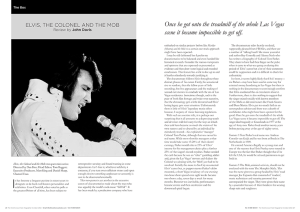
Elvis, the Colonel and the Mob; two-part mini-series; Directed by Dan Bree; Head Editor, Tom Raggett; Executive Producers, Matt King and Daniel Sharp. Channel Four.
It has become a frequent pastime in recent years to denigrate or de-bunk well known personalities and celebrities. Even Churchill, often voted in polls as the greatest Briton of all time, has been subject to retrospective scrutiny and found wanting in some departments. Let’s face it, whichever celebrity it concerns, if you turn over sufficient stones and open enough closets something unpleasant or unseemly is sure to be discovered eventually.
This two-parter is yet another in the extensive canon of documentaries made about the man who was arguably the world’s rock music “GOAT”. It has been made by a production company who have embarked on similar projects before like Marilyn (Monroe) and the Mob so a certain one-track approach might have been expected.
I may be old-fashioned but I prefer my documentaries to be balanced and even-handed like historical research. Consider the various viewpoints and opinions that are expressed or presented as evidence and then draw some logical and rounded conclusions. This feature has a title to live up to and it hurtles relentlessly towards justifying it.
The documentary follows Elvis throughout three distinct phases of his career. Firstly, his sensational rise to stardom, then the fallow years of little recording, few live appearances and the making of second-rate movies to conclude with the era of Las Vegas residencies. Sometimes though, such is the pace of both film footage and voice-over narrative, that the chronology gets a little distorted and Elvis’ lasting legacy gets scant attention. Unfortunately there is little of Elvis’ legendary music either because, I suspect, of music licensing regulations.
With such an assertive title, it is perhaps not surprising that it all amounts to a depressing watch and devotees will feel sorry for the ways in which their cult hero became so much the victim of his own success and so abused by an individual he mistakenly trusted—his exploitative ‘manager’ Colonel Tom Parker, although that was never his real name. While most showbiz managers at that time would take some 15-20% of their clients’ earnings, Parker would rake in 25% of Elvis’ income for his management duties plus a further 25% of the singer’s record royalties. Parker needed the cash because he was an “ultra” gambling addict and, given the Las Vegas’ movers and shakers the Colonel was dealing with, the ‘Mob’ just had to be involved. Initially the move to Sin City resurrected Elvis’ career but, as puppet-master Parker’s debts mounted, a short Vegas residency of one evening two-hour show spaced over eight weeks became two shows a day, seven days a week for many months. Burnout was inevitable, performances became erratic and then incoherent and the downward spiral began.
The documentary relies heavily on detail, supposedly gleaned from FBI files, and there are a number of ‘talking heads’ like music journalist and author Ray Connolly and Alanna Nash who has written a biography of Colonel Tom Parker. They claim to have had their finger on the pulse when it came to what was going on during this period of Elvis’ career but a lot of their comments could be supposition and it is difficult to check for authenticity.
In short, it seems highly likely that Elvis’ money—via Parker—may have been used in some way for criminal money laundering in Las Vegas but there is nothing in the documentary to convincingly confirm that Elvis condoned this or even knew about it. Furthermore, there is also nothing to suggest that the singer mixed socially with known members of the Mafia as did entertainers like Frank Sinatra and Dean Martin. Elvis put too much faith in an unscrupulous adviser and there was a dearth of confidantes who might have been a power for the good. Once he got onto the treadmill of the whole Las Vegas scene it became impossible to get off. The singer died tragically at Gracelands in 1977 at the age of forty-two. Parker lived another twenty years before passing away at the age of eighty-seven.
Footnote 1: Tom Parker’s real name was Andreas Cornelis van Kuijk and he was born at Breda in The Netherlands in 1909.
He entered America illegally as a young man and one of the reasons that Elvis Presley never toured in Europe was the fact that Parker thought that if he left the USA, he would be refused permission to get back in.
Footnote 2: The Mob, criminal activists, should not be confused with the term The Memphis Mafia. This was the name given to a group headed by Elvis’ road manager Joe Esposito that consisted of ‘roadies’, music technicians and security personnel that accompanied the singer. They were given their name by a journalist because of their fondness for wearing sharp suits and sunglasses.