



Looking back at historical moments that happened in April, John Davis highlights Laurence Stephen Lowry
Laurence Stephen Lowry, to give him his full name instead of the customary initials, was a unique artist often disparagingly described as a member of the naïve or simplistic school of painting.
A quiet, self-effacing and unassuming man, Lowry, who lived his whole life in the north of England, died in 1976, fifty years ago, and deserves to be celebrated not only as one of Britain’s greatest artists but also as a shrewd and accurate observer of this country’s social history.
Lowry was born in Stretford, then part of Lancashire. His father worked as a clerk for a property company. He was a distant and introverted man who Lowry later described as ‘a cold fish, nothing moved him’. Lowry always maintained that he had an unhappy childhood growing up in a repressive family atmosphere. At school he made few friends and showed no real academic aptitude.
Much of Lowry’s early years was spent in the leafy suburbs of Victoria Park, Rusholme near Manchester but in 1909, when he was twenty-two, the family seem to have hit on hard times which forced a move to the nearby industrial town of Pendlebury. Tree lined streets and colourful flower bedecked gardens were replaced by a landscape made up of textile mills, terraced housing and smoky factory chimneys. It would change his life. He later remarked, “At first, I detested it, and then, after years, I got pretty interested in it, then obsessed by it.”
After leaving school Lowry began a career working for the Pall Mall Company as a rent collector, a position he held until his retirement at 65. He developed a habit of sketching during breaks in the working day and took private art lessons. He was later to study at Manchester Art School and then on to the Royal Technical College, Salford (now the University of Salford). It was here that he developed his life-long fascination with industrial landscapes and began to fashion his own inimitable style-an impressionist in his own right.
Lowry’s father died in 1932 leaving debts and his mother became bedridden and dependent on her son for care. The daily pattern of life became predictably uniform. He would work long hours, much of his collecting done on foot or by bicycle, look after his mother when he got home until she went to sleep at about 10 p.m. and then paint into the small hours of the morning usually still wearing one of his dark three-piece suits. Industrial landscapes and public events like football matches and fairs continued to feature but there were also small groups of workers out enjoying themselves and a number of portraits of a young lady, the enigmatic Ann whose identity has never been fully established. Lowry’s landscapes that included stylised figures casting no shadows and devoid of weather conditions led to critics describing his paintings as naïve and the work of a Sunday painter.
His observation of the industrial scenes of the north became an irreplaceable historical record as down-turns in the textile trade, general land clearance and new housing schemes did away with factories, chimneys and back-to-back streets. Lowry had always been fascinated by people and the indomitable spirit of northerners who accepted their lot, worked hard and knew how to enjoy themselves when given the opportunity. As the landscape changed, he would often wander down to Manchester’s Piccadilly Gardens where he would sketch individuals often through the windows of a popular cafe. If he lacked a sketchpad, charcoal images were mapped out on the back of envelopes, napkins and old menu cards. In later life he spent holidays on the coast and turned his hand to seascapes although paradoxically many of them lack characters and other features, focussing purely on the light and shade of ocean and sky.
Lowry never married but valued his many friends and acted as an avid mentor to a number of promising artists in the Manchester area. He had a wry sense of humour telling those who asked why all the clocks in his home were set at a slightly different time, that it was because he could not stand them striking simultaneously. One of the artists he mentored, Sheila Fell, described Lowry as a great humanist. “To be a humanist, one has first to love human beings. To be a great humanist, one has to be slightly detached from them.”
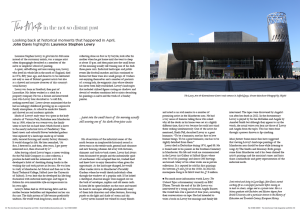
Lowry died in Derbyshire during 1976, aged 88. He is buried next to his parents in the Southern Cemetery in Manchester. His life and work are commemorated in the Lowry Art Gallery at Salford Quays where over 50 of his paintings and almost 300 drawings are housed. Many of his other works are in private collections. It is reputed he sold his first paintings for between £5 and £10 in the 1920s. In 2022 his masterpiece Going to the Match went for £7.8 million.
l For much more information watch Lowry: The Unheard Tapes a documentary currently on BBC IPlayer. Towards the end of his life Lowry was interviewed by a young art historian Angela Barrett. She visited him over a period of four years, recording their conversations on tape. She had intended to write a book on Lowry but marriage and family life intervened. The tapes were discovered by Angela’s son after her death in 2022. In the documentary Lowry is played by Sir Ian McKellen and Angela by Annabel Smith but although they appear to say the words, the actual voices you hear are those of Lowry and Angela from the tapes. This has been done through a process known as lip-synching.
Music footnote: Some music fans have suggested that viewing Lowry’s landscape paintings of the Manchester area should be done while listening to songs by The Smiths and Morrisey. Both groups come from Manchester and it has been claimed the artist’s paintings and the musician’s tunes and lyrics share a melancholic and gritty representation of the industrial north.