



The Odyssey – Documentaries. Review by John Davis.
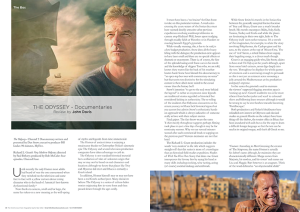
The Odyssey – Channel 5 Documentary written and presented by Dan Snow; executive producer Bill Locke; 90 minutes, MyFive.
Richard E. Grant’s Very Modern Odyssey; directed by Paul Bithrey; produced by Rob McCabe; four episodes, Channel Four.
Until recently the only Homer most adults had heard of was the one encountered when they switched on the television and came face to face with a yellow cartoon donut eating character who is the head of America’s best-known dysfunctional family.*
Now thanks to screens, small and/or large, the name has taken on a new meaning as the well-spring of myths and legends from time immemorial.
The Homer of ancient times is enjoying a renaissance thanks to Christopher Nolan’s cinematic epic The Odyssey and several television production companies have taken advantage to cash in.
The Odyssey is not standard historical material but a collection of tales of unknown origin that may or may not be based on real characters and locations although we know that places like Troy and Mycenae did exist and Ithaca is certainly a Greek island.
In addition, Homer himself may or may not have been a real Greek author/poet. Many classicists believe The Odyssey is a series of culture-laden stories originating first in verse form and then passed down through the ages orally.
It must have been a ‘no-brainer’ for Dan Snow to take on this particular venture. A week criss-crossing the azure waters of the Ionian Sea must have seemed doubly attractive after previous expeditions involving windswept deliveries to camera atop Hadrian’s Wall, hours spent trudging through muddy fields at Waterloo or in Flanders or roasting beneath Egypt’s pyramids.
While visually stunning, this, it has to be said, is a low budget production. Snow does all the heavy lifting with the dialogue; the production crew appears to have been small and there are no special effects or dramatic re-enactments. There is, of course, the hire of the splendid sailing craft Snow uses in his travels and the knowledge of skipper Tom who, we are told, knows these waters like the back of his weather-beaten hand. Some have likened this documentary to “an open-top bus tour with commentary-on water” but that seems too dismissive for the stimulating content is there albeit more suited to the casual viewer than the history buff.
Snow’s intention “to get to the real story behind the legend” is rather an oxymoron since legends are traditional stories regarded as historical but considered lacking in authenticity. The re-telling of the incidents that Odysseus encounters on his return journey to Ithaca lack historical rigour but you cannot but admire Snow’s enthusiastic hands-on approach which is always indicative of someone really in love with their subject matter.
Final gripes. The fact Snow wears the same T-shirt mostly throughout suggests perhaps filming took place in just a few days though it may be for continuity reasons. Why too are several minutes wasted after each commercial break re-capping on the previous part? Viewers memories are not that brief.
The Richard E. Grant production includes the words ‘very modern’ in the title which suggests straight-off that this series is more of a travelogue than an historical field-studies expedition. Shades of Wish You Were Here. Sorry that dates me. Grant intersperses the history bits by trying his hand at many skills including cooking, wine tasting, acting (of course) cocktail making and craftwork.
While Snow limits his travels in the Ionian Sea between the generally accepted former location of Troy and Ithaca, Grant uses a much broader brush. His travels encompass Malta, Italy, Sicily, Tunisia, Turkey and Corfu and while the places are fascinating in their own right, links to The Odyssey itself seem rather tenuous.
It’s a stretch of the imagination, for example, to relate the story involving Polyphemus, the Cyclops giant and his cave, to the craters at the top of Mount Etna. The use of ‘real’ Sirens, a robed Italian choir singing their beguiling songs, is a clever touch though.
Grant is an engaging guide who, like Snow, claims to have read The Odyssey in his youth although, apart from some brief extracts, never digs deeply into the text. Throughout he displays the whole gamut of emotions and is convincing enough to persuade us this is not just an eminent actor savouring a jolly around the Mediterranean at the production company’s expense.
In this series the gimmick used to maintain the viewers’ supposed flagging attention span is ‘coming up next’. Grant’s wardrobe too is far more vibrant from leather jacket and scarf to coloured shirts and billowing linen trousers although it would be wrong to say he ever lurches towards becoming ‘Portilloesque’.
Both productions and Nolan’s blockbuster have rekindled new interest in Odysseus and classical studies in general. Books on the subject have been flying off the shelves, the tourist office in Ithaca has been inundated with calls but as for the urge to learn a difficult foreign language so that the text can be read in its original tongue, well that’s all Greek to me.
*Footnote: According to Matt Groening the creator of The Simpsons, the name Homer is actually his father’s name although, he maintains they are characteristically different. Marge comes from Marjorie, his mother, and his sisters’ real names are Lisa and Maggie. Bart however is an anagram. Think of the word defined as “an objectionable child.”