



Mobbed by crowds wherever she went, Amy Johnson is highlighted by John Davis for her spirit and daring.
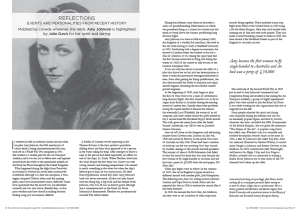
It seemed just like an ordinary routine mission when ace pilot Amy Johnson, the 85th anniversary of whose death is being commemorated this year, took off in a World War Two aeroplane in 1941. She worked as a civilian pilot for the Air Transport Auxiliary and it was her job to deliver new and repaired aircraft from the works to the operational airfields of the Royal Air Force throughout the United Kingdom.
What happened during the flight from Prestwick in Scotland to Oxford has never been conclusively established although it is clear the aeroplane, a twin-engine Airspeed Oxford, often used for training pilots, must have encountered serious difficulty. Some have speculated that the aircraft was not identified correctly and was shot down (friendly fire), or that poor weather may have closed in making location finding using just instruments difficult.
A flotilla of wartime vessels operating in the Thames Estuary at the time spotted a parachute drifting down and later what appeared to be a person in the water calling for help. After attempts to throw a rope to the person had failed repeatedly, an officer on one of the ships, Lt. Cmdr. Walter Fletcher, dived into the water despite the fact there was a heavy sea with strong currents and freezing temperatures. He seemed to reach something in the water but when the ship’s lifeboat got to him, he was unconscious. He died from hypothermia several days later. Amy Johnson’s body was never recovered. All that was later found were her flying bag, a log book and her cheque book. Johnson, who was 38, has no known grave although she is commemorated on the Royal Air Force Memorial at Runnymede. Fletcher was posthumously awarded The Albert Medal.
During her lifetime, Amy Johnson recorded a series of groundbreaking achievements in which she pioneered flying as a career for women and did much to break down the barriers prohibiting long distance flight.
Amy Johnson was born in Hull in January 1903, the daughter of a wealthy fish merchant. She lived in the city until moving to study at Sheffield University in 1923. Graduating with a degree in economics she moved to London where she worked at first for a firm of solicitors. It was during her spare time that she first became interested in flying and during the winter of 1928-29 she started to take lessons at the London Aeroplane Club.
It was not only her desire to master the skills of a pilot that drove her on but also her determination to enter a world that previously belonged exclusively to men. Soon after gaining her flying qualifications, she also demonstrated her ability to maintain and repair aircraft engines, becoming the first British trained ground engineer.
At the beginning of 1930, Amy began to plan the first of what were to be a series of adventurous long-distance flights. Her first objective was to fly in stages from Britain to Australia beating the existing record of sixteen days. Initially there were problems raising the capital needed to finance the venture, but eventually Lord Wakefield, the owner of an oil company, and Amy’s father found the £600 needed to buy a second hand De Havilland Gypsy Moth aircraft. The craft, given the name Jason after the family business trademark, can still be seen in London’s Science Museum.
Amy set off alone on the dangerous and exhausting journey from Croydon near London on May 5th, 1930 and arrived in Darwin on the north west coast of Australia on May 24th. There had been a number of hold-ups on the way involving ‘lost’ days caused by weather, damage to the aircraft and fuel problems. The journey of almost 18,000 kilometres had failed to beat the record by three days but Amy became the first woman to fly single-handed to Australia and she had won a prize of £10,000 from the newspaper, The Daily Mail.
Other epic flights were to follow. In the summer of 1931, she set an England to Japan record in a different aircraft with another pilot, Jack Humphreys. The following year Amy was setting records between London and Cape Town in South Africa and she repeated this feat in 1936 to reclaim her record after it had been bettered.
In 1932 she married the Scots flier, Jim Mollison, and they were to set a number of other important records flying together. These included a non-stop flight from Wales to the United States in 1933 using a De Havilland Dragon. Here they crash landed after running out of fuel and were both injured. They also made a record-breaking journey to India in 1934, this time aboard a De Havilland Comet as part of the England to Australia air race.
The outbreak of the Second World War in 1939 put an end to Amy Johnson’s commercial and competition flying and resulted in her joining the Air Transport Auxiliary, a group of highly experienced pilots who were unable to join the Royal Air Force. It was while working for this organisation that she so tragically lost her life.
Many people admired the spirit and daring Amy displayed during her lifetime and she was an extremely popular figure, mobbed by crowds, wherever she went. Awarded the CBE (Commander of the British Empire), she was given the nickname “The Queen of the Air”. A popular song about her called Amy, Wonderful Amy was recorded and reached the popular records charts at the time. In 1942, a film of Johnson’s life called They Flew Alone was released. Directed by Herbert Wilcox, it starred Anna Neagle as Johnson and Robert Newton as Jim Mollison. In 2023, screenwriter Sally Wainwright, well known for Happy Valley and Last Tango in Halifax, revealed she was interested in writing a drama about Johnson but to date none of the TV channels have taken up the offer.