



Sleep no More by P.D. James – Review by John Davis
Titanic Sinks Tonight – Directed by Hugh Ballantyne – Review by John Davis
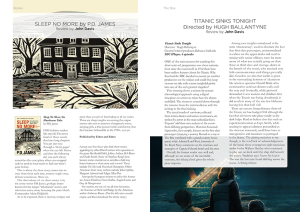
Sleep No More: Six Murderous Tales
by P.D. James
For bedtime readers like myself, I’m never fond of those novels that have long chapters. You get part way through a ‘thirty-pager’ when the eye-lids flutter and then the following day you can’t always remember the exact place where you stopped and/or need to back-track to find out what’s gone before.
This is where the short story comes into its own. Start fresh each time, concise single story, definite conclusion. Move on.
This slim volume of six short stories is by the crime writer P.D. James, perhaps better known for her longer ‘whodunnit’ novels and television series, many featuring the poet/sleuth Commander Adam Dalgleish.
As to be expected, there is mystery, intrigue and more than a touch of foreboding in all six stories. There are sharp insights too among the corpse strewn tales not to mention a hangman’s noose, sleeping pills, a blue poison bottle and that toy that first became fashionable in the 1930s, a yo-yo.
Published by Faber and Faber.
Literary note: For those who find short stories appealing try other British writers who specialise in the genre like Roald Dahl, Jeffrey Archer, H.E.Bates and Zadie Smith. Some of Stephen King’s best-known stories started out as novellas-a half-way house between a short story and a novel. These include The Mist and Shawshank Redemption. Other American short story authors include John Updike, Margaret Atwood and Edgar Allan Poe.
Among the European writers to utilise this format are Anton Chekhov, Franz Kafka, Angela Carter and Guy de Maupassant.
For starters, try one of my all-time favourites, An Occurrence at Owl Creek Bridge by the American author Ambrose Bierce. (Put the title into a search engine and then download the whole story.)
Titanic Sinks Tonight Director: Hugh Ballantyne
Creator/writer/producer, Rebecca Fairbank
BBC IPlayer, 4 episodes
One of the main reasons for watching this short series of programmes was sheer curiosity. Ever since the event itself in 1912 there have been endless features about the Titanic. Why then had the BBC decided to mount yet another production on the subject and could they keep viewers on-side with a more insightful probe into one of the sea’s greatest tragedies?
This showing chose a minute-by-minute chronological approach using a digital timepiece on screen to relate how the drama unfolded. The viewer is counted down through the minutes from the initial collision with the iceberg to the final sinking.
The actual words of survivors, collected from letters, diaries and witness testimonies, are spoken by actors in the main unfamiliar faces. ‘Experts’ add their own analysis of the events from differing perspectives. Historian Suzannah Lipscombe, for example, focuses on the first-class passengers (enjoying a journey likened to a stay at The Ritz combined with a grand country house party) while Admiral Lord West, formerly of the Royal Navy, comments on the reactions and strategies of Captain Edward Smith and his crew.
Overall, the format works very well and, although we are aware of the inevitable outcome, the ticking clock gives the whole piece impetus.
Among new insights introduced is the term ‘chumocracy’, used to illustrate the fact that first class passengers, accommodated in cabins on the upper decks and used to mixing with senior officers, were far more aware of what was actually going on than those in third class and steerage, down in the bowels of the vessel, who received very little communication until things got really dire. Good to see also that credit is given to the outstanding heroism of characters like wireless operator Harold Bride who continued to send out distress calls until the very end. Ironically, while protocol demanded it was women and children first when the Titanic was being abandoned, it did result in many of the too few lifeboats leaving less than half full.
There are caveats. Long-distance shots of the Titanic are low-budget CGI although the fact that all events take place totally in the dark helps. Hard to believe also that such an experienced seaman as Capt. Smith, while needing to appear calmness personified as the situation worsened, could have been as unresponsive and inanimate as portrayed in the drama. The glaring omission to me though, is the total lack of acknowledgement of the band, those courageous eight musicians under leader Wallace Hartley who continued to play out on deck until the ship slid beneath the waves. Tradition says Nearer My God to Thee was the last tune heard drifting across the ocean. A fitting tribute.