



Ahead of the release of his first full-length feature film, George Earwicker talks to Fergus Byrne about some of the themes explored in it.
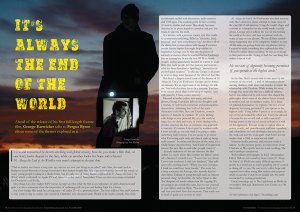
In a world consumed by doom-scrolling and global anxiety, how do you make a film that, on one level, looks despair in the face, while on another looks for hope and a future? It’s Always the End of the World is one man’s attempt to do just that.
“Did we forfeit our future a long time ago and are we now just living in an echo?” asks Max, the male lead in Bridport-based filmmaker George Earwicker’s first feature-length film. It’s a question that has crossed the minds of many young people looking at a bleak future, but it’s only one of many themes explored in It’s Always the End of the World, which is released on Apple TV and Amazon at the end of November. There are also screenings scheduled for Dorchester and Poole.
Describing it as a low-budget ‘DIY’ movie, George says that while the film is an exploration of grief, depression and guilt, it is also a statement about the importance of reckoning with the past and finding hope for a future.
For a low-budget film made by a young crew—all under 25—it’s a powerful effort. The story follows Max and Charlotte as they come to stay in a cabin once owned by Charlotte’s now-deceased uncle. Buried in the bushes outside, Max finds an old trunk stuffed with documents, audio cassettes and VHS tapes. The contents point to half a century of secrets, murder and worse. Max slowly becomes obsessed as he pieces together a timeline and gets lost trying to uncover the truth.
It is intense, with a pressure cooker style that builds to an emotional reckoning. Billed as “inventive, bold, personal” and “with something to say,” the film is all of the above, but a conversation with George Earwicker reveals further depths that might help explain its inspiration. George says he first saw the power of intensity in movies when he watched Steven Spielberg’s Jaws as a young boy. It was the first DVD his family bought, and he immediately decided he wanted to make films that made people feel that potency and tension—what has been described as Spielberg’s “masterclass in psychological suspense”. To this day George is reluctant to swim in deep water because of the effect of that film.
But there’s a deeper reason some of the themes of It’s Always the End of the World exist. George says he thrives on intensity. ‘It’s an expression of my feelings’, he tells me. ‘And with that there has to be a sincerity. You have to be sincere about what you’re trying to express. And with sincerity, I think, comes intensity.’
Dressed in leather jacket, torn jeans, and dark glasses, George Earwicker delivers his thoughts with a mixture of well-worn conviction and contemplative observation. Admitting that both of the main characters in the film, Max and Charlotte, contain aspects of himself, he explains: ‘If you’re dealing with things in your personal life, or in the world at large, that are dark and scary, or you’re dealing with a positive emotion like love or romance, you approach it sincerely. It’s intense. I do it quite by accident really. I don’t actually go out and think I’m going to make something really intense. I’m just going to go about what I’m feeling right now, and then it ends up being really intense.’ As writer and director of the story, it’s a totally honest emotive force. ‘And I kind of forget how intense this new film is until other people watch it.’
An early indication of the raw emotion the film tackles is a scene where Max scatters his father’s ashes off a blustery Cornwall coast. “I never saw you shout. I never saw weakness. I only saw kindness,” Max calls out to the crashing waves. “When you were younger, I think we could have been friends.” The scene has a deep resonance for George, who recently lost his own father. Talking of going through such an ‘intense personal thing’, he describes the father figure as like ‘the blueprint of maybe where your life is going. It’s not going to go exactly the same, but you see yourself in your father, and you think, “You know, that’s me,” and then you don’t have that anymore. That north star to kind of guide you on how to exist.’
It’s Always the End of the World treads into dark territory with Max’s obsessive, manic attempt to make sense of the case full of information. Using the trunk’s shape and contents as a metaphor for the world inside a mobile phone, George says it reflects the way he was viewing the world at the time, and how we interact with the world at large on our phones. ‘We see all these terrible things happening that we’re completely helpless to stop. All the time just getting them into our phones, and so I wanted to make something that explored that idea.’ Obsessive online ‘doom-scrolling,’ he says, is us trying to find patterns in life. Trying to find that one thing that makes sense of it all.
In the film, Max’s mental state is torn apart by the contents of the trunk—a trail of information about missing children, child abuse and murder. It strains his relationship with Charlotte. While writing the story, George was aware that this was a difficult subject, but he was influenced by real events that shaped his philosophy about some of the darker forces at work in modern and not-so-modern society. ‘It’s a form of political domination’, he explains. He sees acts of depravity becoming permitted ‘if you operate at the highest circle.’ Using Jeffrey Epstein as an example, he says everyone looked the other way. ‘Everyone allowed it because he was so rich and so well connected.’ George points to the use of sexual violence as a tool of the oppressor. ‘I’m just trying to explore ideas of power, cruelty, and powerlessness, and how capitalism and colonialism are both ideologies that just prey on the weak and tear the weak apart. And there’s no one weaker than a child, an unprotected child.’
Intensity builds pressure, and pressure needs a release. As the pressure grows, we learn more about Charlotte as Max spirals into his trunk scrolling. The end is perhaps unexpected.
With brilliant photography by local videographer Elliott Millson and sound by Lewis Lenk, It’s Always the End of the World asks many difficult questions. It points to a world not so much spiralling out of control as tilting off its axis. On one level it offers hope and inspiration to other young film makers and creatives while on another it may be an insight into the perils envisioned by coming generations.
Local screenings are at The Lighthouse in Poole on November 14th and Dorchester Arts Centre on 17th November.
For more information visit: https://thesandbagos.com/