



Fanny Charles goes on a successful treasure hunt in Dorchester
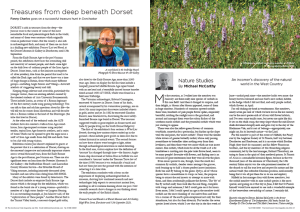
DORSET is rich in treasures from the deep—the Jurassic coast is the source of some of the most remarkable fossil and paleontological finds in the world, and many of them were creatures which originally swam in prehistoric waters. But the county is also rich in archaeological finds, and many of them are on show in a thrilling new exhibition Treasure! Lost and Found, at the Dorset Museum & Gallery in Dorchester, until 13th September.
From the Early Bronze Age to the pre-Norman period, this exhibition showcases the astonishing skill and creativity of ancient people, and sheds some light on the daily lives of ordinary people of the Iron Age in Dorset. Some items, such as the intricate masterpieces of silver jewellery, date from the period that used to be called the Dark Ages and that we now know was a time of huge change in Britain, from which many different groups—including Anglo Saxons and Vikings—have left artefacts of staggering beauty and skill.
Keeping things relevant and accessible, particularly for younger visitors, there are exciting exhibits created by the talented students of Arts University Bournemouth. These include Lucius, an avatar of a Roman legionary of the first century, made using gaming technology. You can talk to him and ask him questions about his life—he will tell you he comes from Macedonia and will describe life as a Roman soldier in the land of the Durotriges (the tribe that lived in Dorset).
At the other end of the technical scale, the AUB students have also created a walk-in Iron Age round-house, Iron Age-inspired costumes using recycled textiles, typical Iron Age domestic artefacts, and a series of boxes which can be opened to give the eager nose a sniff of Iron Age smells from daily life and death. Sure to be a hit with young visitors.
Exhibition curator Jon Marrow explained to guests at the preview that it is a celebration of Dorset, drawing on the museum’s impressive and nationally important objects across several thousand years, from the Early Bronze Age to the post-Roman, pre-Norman era. There are also significant items on loan from the Potteries Museum & Art Gallery—the Staffordshire Hoard—and Lancashire County Museum Service—the Silverdale Hoard of Viking treasures, including intricately decorated silver bracelets and rare silver coins dating from 880-900CE.
Many of the exhibits were found by detectorists. The Dorset finds include an exquisite Early Bronze Age mirror which is the image for the exhibition, which was found in the burial site of a young woman—probably a member of a high status family—at Langton Herring. It is an outstanding example, as Jon Marrow said, of the “sophistication of these people.” Another Dorset find is the Tarrant Valley lunula, a crescent-shaped gold collar, also dated to the Early Bronze Age, more than 3,000 years ago. Items on display for the first time include a uniquely preserved Middle Bronze Age rapier buried with an axe head and a beautifully incised bronze bracelet dated around 1400-1275 BCE, which were found in a field near Stalbridge.
The Victorian archaeologist, Edward Cunnington, excavated 46 barrows in Dorset. Some of his finds, several accompanied by his watercolour paintings, are on show. His many important discoveries included objects in gold, amber and jet. In 1882 he excavated Clandon Barrow, near Martinstown, discovering the most richly-furnished Bronze Age burial in Dorset. The treasures suggested wealth or great exploits in distant travel and trade by people living on the South Dorset Ridgeway.
The first of the exhibition’s four sections is What Lies Beneath, showing how ancient objects ended up in the ground—these include grave goods or items lost due to violent historical or natural events. The second focuses on how these objects were brought to light, either through archaeological excavation or metal detecting. In the third area, visitors explore how the definition of ‘treasure’ has changed through time—the famous Anglo-Saxon ship discovered at Sutton Hoo in Suffolk was not considered a ‘treasure’ under the Treasure Trove law of the time (1939) because it was technically a burial and had not been put into the ground with the intention of retrieving it at a later date.
The exhibition concludes with a focus on the importance of displaying archaeological finds in museum, showing how continued research and new technologies help experts to reconstruct ancient lives, enabling us all to continue learning about our past. New scientific research shows changes in our thinking about the early peoples of the British islands.
Treasure! Lost and Found is at Dorset Museum and Art Gallery, High West Street, Dorchester until 13th September 2026.