



A chance encounter in a Bridport pub led author Paul Lashmar to visit Sharon Cooke, a British-Bajan horticulturist, at the Andromeda Botanic Gardens in Barbados
I first met Sharon Cooke in the Woodman pub in Bridport sometime in early 2022. I was sitting with some friends and a pint of Isaac’s cider when a woman with dreadlock hair came over and asked me in a decidedly London accent, ‘Aren’t you that man who writes about the Drax family and Barbados?’ ‘Yes’, I replied. ‘Well’ said my new acquaintance, ‘I wrote to that Richard Drax and told him he should hand over his Drax Hall Plantation to the people of Barbados. But you will be surprised to hear I have not had a reply’. She then introduced herself as Sharon and explained she was British-Bajan.
A horticulturist, Sharon and her partner Rob had taken refuge in Bridport during Covid, as Rob has family nearby. Barbados had very strict lockdown during the pandemic and she had to close the eight-acre Andromeda Garden which was normally open daily to the paying public.
If you visited Bridport around that time, you would have found Rob selling his home-made bread in the market. Sharon and Rob were living in a small two-up, two-down rental in South Street in which Sharon had, in no time, transformed the small garden. It was unique enough to make a slot on Monty Don’s Gardener’s World programme on BBC in 2020.
Richard Drax is the extremely wealthy, then MP, who owns the vast Charborough Estate in East Dorset. For two hundred years his ancestors worked enslaved African people on the 621 acre Drax Hall sugar plantation in brutal conditions. Sharon was one of the many black Bajans and diaspora who have a legacy in that slavery and believe that the Drax family should apologise and make reparations. We kept in touch but a few months later Sharon said she was going back to Barbados, and we lost contact.
In early April I was giving a lecture at the Barbados Museum based on my book Drax of Drax Hall. Afterwards I was pleased to see Sharon who said she had really liked my talk and suggested that my wife and I should visit Andromeda Gardens during our stay. We had heard good things about Andromeda through a friend who does tours at Welchman Hall Gully, another amazing Barbados National Trust property, where some the original flora and fauna of Barbados survive (most was decimated by the sugar plantations that blanketed the Island from the 17th century onwards). Both the Gully and Andromeda are run as commercial entities by enterprising women horticulturists and had been hard hit financially by the pandemic. So, later in the week three of us went up to Andromeda taking the winding roads through many sugar plantations.
Andromeda is to be found high up on the eastern part of the Island near the village of Bethsheba. There is nothing quite like it. It has stunning views over the wild East coast where the Atlantic waves crash in white foam. Sharon has created an extraordinary horticultural experience, which is also a community asset. Bajans get in free.
Andromeda was established as a private botanic garden by the late Iris Bannochie (three Gold medals at the Chelsea Flower Show, Silver Crown of Merit issued by the Barbadian government and much more) from the 1950s. Sharon pointed out that at that time, Barbados was simply a land exploited for sugar, and a country without a long history of garden creation. She said, ‘I took over the management and development of Andromeda Botanic Gardens in February 2014, after being requested to do so by the Barbados National Trust. …. Being responsible for Andromeda was not even a dream. It was something beyond my imagination.’
She added that she knew it needed a lot of renovation.’ The first time I’d visited was as a child in 1977, returning as an adult in 1994. Andromeda had changed but I couldn’t articulate what that was—anyway, gardens do change!! I returned numerous times between 2002 and 2012. Andromeda was silently asking for help.’
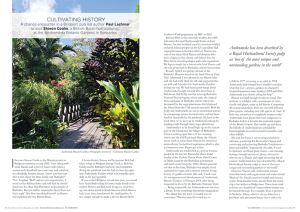
Sharon was kind enough to take us round. Her aesthetic is a delight, with a cornucopia of trees, shrubs and plants, many in full bloom. Comprising 20 connected gardens, there are over 600 different plant species, including over 100 species of trees. ‘It feels very natural yet is completely woman-made.’ Andromeda hosts plants that were indigenous to Barbados before it became the economic engine of the British Empire. Our ramble up and down the hillside of Andromeda was attended by hummingbirds, beautiful monarch butterflies and other wildlife.
She said her focus is on ensuring community inclusion, protecting Iris Bannochie’s legacy and conserving and enhancing Barbados’ biodiversity—plant and wildlife.’ Importantly she adds, ‘I want to showcase our Bajan plant stories—our amazing heritage through our use of plants, relevant to who we are as Bajans and super-interesting for all visitors.’ Andromeda has been described by a Royal Horticultural Society judge as ‘one of the most unique and outstanding gardens in the world’.
However, Sharon said, Andromeda remains misunderstood, underappreciated and under-visited. Much of the Island’s tourism footfall and revenue comes from minibus tours, mostly from the cruise ships that anchor in Bridgetown. These tours tend to focus on a handful of venues where visitors can be hurried through. For example, there is pristine St Nicholas Abbey, which is not an abbey but a Jacobean style plantation house that is said to be the second oldest residential house in the Americas (circa 1658). Only the very private Drax Hall is older, as it was built in the early 1650s by Sir James Drax. The St Nicholas plantation was bought some years ago by the Warren family headed by Barbados architect Larry Warren—who have no ancestral relationship with slavery and have polished St Nicholas’ charm for tourists.
Barbados still struggles with the legacy of slavery. When I visited St Nicholas Abbey in 2022, I was amazed that the owners made almost no reference to the fact that the plantation was worked by enslaved people for two hundred years. On this year’s visit, we noticed there has been a slight improvement. In their guide handout, Larry Warren accepted that the venue had not been good at explaining that those who worked on the plantation had been enslaved, ‘our future plans are to professionally upgrade the House Museum to correct this disparity.’ But they have a long way to go to explain Barbados colonial history. St Nicholas has no problem with footfall as a constant stream of minibuses delivers tourists. Andromeda and Welchman’s Hall Gully see little of these visits. And what they miss. But some cruise tourists do make it to Andromeda, as do celebrity visitors. Alan Titchmarsh told the Sunday Times in 2020, “We’ve been cruise fans for many years and have seen a lot of the islands, but I particularly like Barbados. I’ve visited the wonderful Andromeda Botanic Garden on the island”.
For capital projects, Andromeda depends on sporadic donations from foundations and the public. Endlessly energetic, Sharon is currently ‘Africanising’ parts of Andromeda in tribute to the majority enslaved Africans that gave so much to the island and who understood the medical and herbal applications of certain plants. Take, for instance, the Pride of Barbados, which is today the national flower of Barbados. This is a flowering shrub native to the tropics and subtropics of the Americas. By drinking the seeds, leaves, or flowers of the plant in tea form, enslaved women could induce a miscarriage. This was understood as an act of resistance: by not having children, enslaved women were limiting the profits enslavers could make off their bodies. Other Andromeda plants had ethnobotanical uses such as ritual, medicinal and as food.
Sharon is determined to make it work. ‘We hope Andromeda will, one day, be valued and admired and Iris Bannochie, the queen of Barbadian horticulture and creator of this masterpiece, will not be forgotten.’
Dr Paul Lashmar is the author of Drax of Drax Hall: How One British Family Got Rich (and Stayed Rich) from Sugar and Slavery. Pluto Books (2025).