



Looking back at historical moments that happened in January, John Davis highlights Louis Braille.
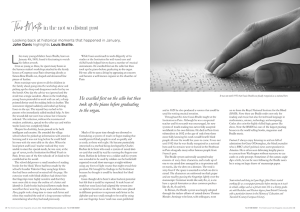
Like many young children Louis Braille, born on January 4th, 1809, found it fascinating to watch his father at work.
Even as young as three, he spent many hours in the harness maker’s workshop attached to the family house at Coupvray near Paris observing closely as Simon Rene Braille cut, shaped and decorated fine pieces of leather.
Stern warnings were given to all the children in the family about going into the workshop alone and picking up the sharp and dangerous tools that lay on the bench. One day the advice was ignored and the result was a tragic accident. Alone in the workshop, young Louis pretended to work with an awl, a sharp pointed device used for making holes in leather. The instrument slipped suddenly and ended up hitting Louis in the eye. The injured boy rushed to his parents who immediately called medical help. At first the wound did not seem too serious but it became infected. The infection, without the treatment of modern antibiotics, spread to the other eye and within weeks Louis was completely blind.
Despite his disability, Louis proved to be both intelligent and creative. He attended the village school where he picked up information with attentive listening and it was not long before he could hold his own with the most able in the class. When the local priest and Louis’ teacher realised they were unable to meet his special needs, he was sent, at the age of seven, to the Institution for Blind Youth in Paris. It was one of the first schools of its kind to be established in the world.
The school did possess a small number of reading books for the blind. These had been made by the school’s founder Valentin Hauy using large letters that had been embossed or raised off the page. His extensive work with blind children had shown him that fingertips were highly sensitive and that they were soon able to trace the outline of a letter and identify it. Early books had raised letters made from wood but these were big, heavy and cumbersome. Also, pupils took a long time to trace each letter and often they reached the end of a long sentence without remembering what they had read previously.
While Louis continued to work diligently at his studies at the Institution his well-tuned ears and skilful hands helped him to learn a number of musical instruments. He excelled first on the cello but then took up the piano before graduating to the organ. He was able to earn a living by appearing at concerts and became a well-known organist in the churches of Paris.
Much of his spare time though was devoted to formulating a system of touch or finger-reading that would permit blind people to read as quickly and as easily as those with sight. He became particularly interested in a method being developed by Charles Barbier de la Serre who used a system of raised dots on card that could by read by running the fingers over them. Barbier de la Serre was a soldier and his system was intended to be used by soldiers on the battlefield expected to read short messages at night without using any form of light source that might reveal their position. He brought his findings to the Institution because he thought it could be beneficial for blind people.
Louis thought de la Serre’s ideas had real potential but felt that it could be improved. It took hours of work but soon Louis had adapted the system into an alphabet based on six dots. The dots were placed in different positions to represent each letter in the alphabet and was small enough to be read by using just one fingertip. Louis’ work was soon published and in 1829 he also produced a version that could be used for writing musical notation.
Throughout this time Louis Braille taught at the Institution in Paris. Although he was a respected teacher and his research was encouraged, his new system of touch reading was never fully accepted worldwide in his own lifetime. He died in Paris from tuberculosis in 1852 at the age of only forty-three never fully knowing his work would benefit blind people all over the world for years to come. It was not until 1952 that he was finally recognised as a national hero and his remains were re-buried in the Pantheon in Paris alongside many other famous people from France’s past.
The Braille system universally accepted today consists of sixty-three characters, each made up of one to six raised dots arranged in a six-position cell or matrix, like the dots on a domino. The total is sixty-four if the space is counted in which no dot is raised. The characters are embossed on thick paper and are read by passing the fingertips lightly over the manuscript. Common words like and, the, it, is etc. have a special formation as does common prefixes like ch, th, sh and wh.
In Britain, the Braille system was largely adopted through the tireless efforts of retired doctor Thomas Rhodes Armitage who later, with colleagues, went on to form the Royal National Institute for the Blind (RNIB). Now there are Braille codes not only for reading and music but also for technical language in mathematics, science, technology and computing. Codes also exist for highly skilled logic games like chess. Now the RNIB has one of the largest printing houses in the world selling books, magazines and Braille music.
Footnote: I always enjoy listening to and am full of admiration for Gary O’Donoghue, the blind journalist who is BBC’s chief political news correspondent in America. He is often seen delivering lengthy pieces to camera from Washington without recourse to cue cards or a tele-prompt. Sometimes if the camera angle dips a little, he can be seen following the Braille notes he is using on large sheets of manuscript paper.