



An early adopter of solar power, Christopher Roper asks questions about inherent risks and regulatory oversight on plans for local energy storage
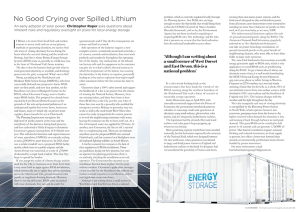
If Britain is to move from fossil fuels and nuclear reactors to water, wind and sun as our primary methods of generating electricity, we need to find safe ways of storing electricity for use during the hours when the sun isn’t shining and the wind isn’t blowing. And this is where Battery Energy Storage Systems (BESS) come in, possibly to a field near you, in the heart of Marshwood Vale’s home territory.
The idea is that the batteries load up with solar or wind generated electricity, as available, and discharge power onto the grid, as required. What’s not to like?
Plenty, according to the Hawkchurch and Monkton Wyld Action Group (HMWAG), who have successfully defeated one proposal to locate BESS units on their patch, and now face another, on the Hazelhurst site close to Blackpool Corner on the B3165, where Clearstone Energy want to build a major BESS facility. This proposal has already been rejected by East Devon District Council on the grounds of fire risk and potential pollution of an underground aquifer that serves farms, businesses and homes, many of which rely on private water supplies, down towards the sea at Charmouth.
The Planning Inspectorate recognises the high level of public interest in the issue and the complexity of the decisions facing local planners, and have authorised a Public Enquiry to determine Clearstone’s appeal, running from 10-14 March next year. This will involve barristers and expert witnesses of many specialities; HMWAG are currently seeking to raise £100,000 to meet their costs. In 2023, there was a similar standoff over a proposed BESS facility nearby, which went to a public enquiry and the Action Group was successful, at a cost of £70,000 all donated by a single local resident. This time they hope to spread the burden.
If you accept the reality of climate change and the need for the U.K. to transition away from fossil fuels, it may seem hard to argue against BESS installations, which intrinsically are no uglier than pylons marching across the Marshwood Vale, ground mounted solar panels, or megabarns housing livestock. However, there is one big difference; BESS units are packed with toxic chemicals; they can and do catch fire spontaneously; and if they do the consequences are serious and hard to control.
Safe operation of the batteries requires a very complex system—commonly monitored remotely—of sensors, controls and ventilation, that must work perfectly and seamlessly throughout the operating life of the facility. Any malfunction of the lithium ion battery cells and the equipment in the container can give rise to what’s called a thermal runaway in which the temperature of the battery rises causing the electrolyte in the battery to vaporise, potentially leading to a fire and an explosion that might engulf other containers before the fire service has time to arrive.
Clearstone claim a 100% safety record and suggest the likelihood of a fire is no greater than the chance of winning the National Lottery. However, there are winning tickets, and there have been at least three BESS fires in the UK just this year. One of those fires was seen by a passerby who notified the emergency services. Relying on passersby may not work so well in the rural South West! These fires cannot be easily extinguished; the current practice is to cool the neighbouring containers with water, leaving the container on fire to burn itself out. At a fire in Liverpool, water was applied for 59 hours. At another, near Cirencester, the fire set off a second fire in a neighbouring unit. There are no hydrants anywhere near the proposed BESS sites around Hawkchurch, and last summer local firefighters were all deployed fighting wildfires in South Dorset.
A further concern for everyone is the lack of clear regulation of BESS installations. There are guidelines, laying out best practice, but once an operator has planning permission, there is no authority checking the installation or its safe operation. The Cirencester fire occurred on an installation that had been in place for two years without incident. Clearstone’s application envisages a forty-year life for the Hazelhurst site, without any further external inspection or certification, unless new legislation comes into force.
Although I am writing about a small corner of West Dorset and East Devon, this is a national problem, which is currently regulated locally through the Planning System. Few BESS sites are large enough to meet the thresholds that would bring them within the COMAH (Control of Major Accident Hazards) framework, and so far, the Environment Agency has not been involved in regulating or inspecting BESS sites. The technology and the risks that it presents are so new that few local authorities have the technical bandwidth to assess them.
It is also worth looking back at the circumstances that have made the stretch of the B3165 running along the northern boundary of the Marshwood Vale such a focus of interest to renewable energy operators.
Some fifteen years ago, in April 2010, with unusually consensual support from the House of Commons, the government introduced generous subsidies to encourage small-scale generation of electricity using wind turbines, photovoltaic solar panels, and, less frequently, hydroelectric turbines.
The legislation had the desired effect and wind turbines and solar panels began popping up wherever you looked.
More generating capacity would have been installed nationally, but for limitations imposed by the structure of the National Grid, which was designed between the two world wars, when generation was limited to large, coal-fired power stations in England and hydroelectric turbines in Scotland. Its designers had not considered the possibility of homes and farms creating their own micro power stations, and the Grid wasn’t designed to take and distribute power from all comers; most homeowners were restricted to installing no more than 4 kilowatts of panels on their roof, or if you were lucky, as we were, 10kW.
This infrastructural limitation explains the rash of ground-mounted panels along the B3165. The Axminster National Grid Substation, popularly referred to as ‘the Hawkchurch Substation’, can take on power from large installations of ground-mounted panels to the great benefit of neighbouring farmers, who were able to lease their fields to large-scale operators.
The same Grid bottlenecks that constrain renewable energy generation apply to BESS units, which is why applications to install BESS units are proliferating along the B3165. To get a better idea of where our electricity comes from, it is well worth downloading the NESO (National Energy System Operator) app onto your phone or tablet. Sitting in Wootton Fitzpaine on 22 November, on a wet and windy morning, I learn that for the U.K. as a whole, 48% of our electricity comes from zero carbon sources; while Scotland is 100% zero carbon; and the Southwest of England only 25%. This balance changes with the weather and the light throughout the day.
The only unarguably safe way of storing electricity is exemplified by the Dinorwig Power Station in North Wales which operates between two reservoirs, pumping water from the lower to the higher reservoir when demand for electricity is low, and running it back through turbines to meet peak demand. This giant BESS can be switched to full power in 16 seconds and can generate 1,728MW of power. This kind of installation requires national thinking and national investment, in short supply at present, but offers a better way forward than untried, environmentally problematic local schemes funded by private investment.
For more information: email: hawkchurchactiongroup10@gmail.com