



I enjoyed a childhood immersed in the Dorset countryside. Dad was a postman, Mum a stay-at-home mum, who loved their garden. I have fond memories of helping on local farms with haymaking, building dens in the woods, and always being outside.
We lived near Weymouth and my first job after school was on the RMAS boats in Portland Harbour. Later I became a ranger on the Lulworth Army Ranges, and from there I started a grounds maintenance business. That was inevitably seasonal, busy in spring and summer, so when I saw a TV programme featuring a hedgelayer, whose work was concentrated in the winter months, I got interested.
At that time, Kingston Maurward College ran hedgelaying courses, so I enrolled. It lasted only three days, at the end of which we got a certificate of attendance. It’s fair to say most of those attending were there because learning a bit of hedgelaying was on a retirement bucket-list, or they had a garden hedge which needed laying, or it was a birthday present, but for me, that was 27 years ago, and I’ve been doing it ever since and am still learning with every new hedge.
Over the years I’ve been lucky enough to have been awarded many accolades including four times Dorset National Champion, and many competition titles throughout the South and South West. I’ve also judged two National Hedgelaying Championships in Ireland.
I’m committed to it, because I’m outdoors in all weathers, working with a living hedge which, after I’ve laid it, will provide habitat and a food source for small mammals and birds, create an aesthetically pleasing stock-proof barrier, and breathe life back into a feature that may have shaped the landscape for centuries.
I mainly work all over Dorset, but have laid hedges in Wales and France. The hedgelaying season is between September and the end of March, although that can vary from one year to the next. I’m basically working when the hedge plants are dormant, and am mindful of when the birds are nesting. But to work on the land and be governed by the seasons is a privilege.
My tools are simple; a doubled bladed billhook, commonly known as a Yorkshire, which can be used as a short axe; a felling axe, and a small chainsaw. The principles of the job are also simple, but the techniques required to create an effective, tidy, and pleasing hedge need a lot of practice and can be physically demanding. In this work, you’re not so much thinking about what the hedge looks like when you move on to the next job, it’s more about what will happen during the rest of the hedge’s life, or when it’s next laid, and that’s really satisfying.
After cutting and clearing out the unwanted growth on the sides of the hedge, the fundamental part of the job, making the cut, is called pleaching, which involves cutting part-way through the vertical stems, or pleachers, near their base, allowing you to bend them so that they lay horizontally instead of vertically, forming a dense and tidy structure. Crucially the pleachers must not break as they bend. The thin top growth is then trimmed and woven or tucked into the laid hedge, according to the style of hedge laying followed. The pleachers will then continue to grow and be stimulated to produce new vertical shoots.
There are many styles of hedge laying, and many which have disappeared, which are local to particular areas; but it’s not hard and fast, so it’s more important that the style used will suit the purpose and characteristics of the hedge, regardless of the area. The styles I work to are the Dorset, a low flat hedge predominantly on a bank, a style suited to the control and shelter of sheep on downland. The pleachers are laid as low as possible, building a strong intertwined hedgerow. If required, hazel binders or bonds can be tucked under a pleacher on one side, and passed over the hedge at an angle of about 30° and tucked under the other side. The other style I work in is the South of England style; in this the hedge is cut and laid over to create a double brush, and a single line of stakes 18″ apart are driven into the centre of the hedge, with the top bound with hazel. String or wire should never be used in any hedge laying.
Hedges can be single species or mixed; the ancient hedgerows contain many species. Each species requires a different approach, but personally I like to work with a mixed species hedge, with a bit of holly, beech, dog-rose, thorn, and hazel all making a nice combination. In all the years I’ve been doing it I’ve probably worked single-handed for over 95% of the time, but occasionally I might need a bit of help with a large overgrown hedge.
In the summer months, I’m often at the country shows exhibiting and demonstrating, such as Melplash Agricultural Show, Sherborne Castle Country Fair, Stock Gaylard Oak Fair and Dorset County Show. As well as the main show in August, where I’m the Hedgelaying Chairman, Melplash holds a ploughing and hedging match, which is the origin of the show. I’ve taken many Hedging Competition wins from my first competition in 2000 to the present day. I also run courses for those who want to learn the craft.
There have been some surprising diversions during my career as a hedgelayer. In 2022 I took part in a rather different kind of competition, one that was as much about television as it was about tradition. This one-off event was staged at Jeremy Clarkson’s Diddly Squat Farm in Oxfordshire for the hit Amazon Prime series Clarkson’s Farm. Featured in Series 2, Episode 6, Counselling, the “Diddly Squat 2022 Hedgelaying Competition” brought the craft to the attention of a worldwide audience. Against the backdrop of Clarkson’s often unconventional approach to farming, the competition highlighted the genuine skill and heritage of hedgelaying. It was an opportunity to showcase my experience and craftsmanship, and I was delighted to come away as the winner of the Dorset Class.
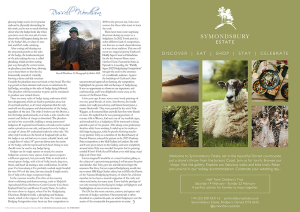
A few years ago, I came across some lovely paintings of two very good friends of mine; Alan Brown, the hurdle maker, now sadly passed away, and Simon Grant Jones, a master blacksmith. They were painted by the artist Toby Wiggins, so I contacted him and told him they were friends of mine. He replied that he was painting portraits of country folk in Wessex, had seen one of my roadside signs, and wondered if, as a hedgelayer, I’d be interested in being painted as part of his project. After doing some preliminary sketches while I was working, I ended up in his studio, in full hedge laying gear, while he put the finishing touches to my portrait. Toby, as a member of the Royal Society of Portrait Painters, entered the picture in the 2023 Ondaatje Prize competition at the Mall Gallery in London. My wife and I were given tickets to the Gallery, and were completely amazed when Toby was awarded first prize for his painting, entitled Winter’s Work; Russell Woodham at rest while laying a hazel hedge in the Dorset Style.
I never imagined I would be at a smart London gallery, as the subject of a prizewinning painting. I will treasure the print and sketches that Toby gave me and will never forget the occasion. But then, I never expected hedgelaying would take me to meet HM King Charles either, but as HM is the Patron of the National Hedgelaying Society, of which I’m a lifetime member, he has been a staunch supporter of the craft, and other rural crafts, for many years. I have had the privilege of not only meeting him but laying his hedges at Highgrove and Sandringham on six or seven occasions.
The UK has the most extensive, ancient, and species-rich network of hedges anywhere. Our countryside is often described as a patchwork quilt, on which hedgelayers sew the seams of the countryside for generations to come.