



Looking back at historical moments that happened in March, John Davis highlights Donald Campbell
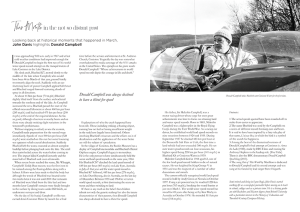
It was approaching 9.00 a.m. early in 1967 and at last cold weather conditions had improved enough for Donald Campbell to begin the first run of his world water speed record attempt on the tranquil waters of Lake Coniston in the Lake District.
His sleek craft, Bluebird K7, moved slowly to the middle of the lake where Campbell, who would have been 46 in March of that year, paused briefly to correctly align the craft. Suddenly with an ear-shattering burst of power Campbell applied full thrust and Bluebird surged forward scattering clouds of spray in all directions.
At about 113km per hour (70 m.p.h.) Bluebird slightly lifted itself from the surface and rocketed towards the southern end of the lake. As Campbell increased the revs, Bluebird passed the start of the official measured kilometre at about 460 km per hour (285 m.p.h.) and had reached 475 km per hour (298 m.p.h.) at the end of the required distance. So far, so good, although observers in nearby boats and on shore were already noticing slight variations in the watercraft’s performance.
Without stopping to refuel, as was the custom, Campbell made preparations for the second stage immediately. Speeds of over 500 km per hour (328 m.p.h.) were reached on this run but some bouncing was apparent which caused deceleration. Suddenly Bluebird left the water, executed an almost complete backflip before plunging back onto the lake. The craft then cartwheeled across the water before coming to rest. The impact killed Campbell instantly and the main hull of Bluebird sank soon afterwards.
When rescue boats reached the scene, Mr. Whoppit, Campbell’s Teddy Bear mascot, was the first item to be noticed among the floating debris along with a helmet. Efforts were later made to find the body but although the wreck of Bluebird was located some two weeks later it was not until 2001 that remnants of Bluebird were lifted from the lake bed and two months later Campbell’s remains were finally brought to the surface by diving teams under Bill Smith, an underwater surveyor and diver.
On the day of his burial, Campbell’s coffin was carried down Coniston Water by launch for a final time before the service and interment at St. Andrews Church, Coniston. Tragically the day was somewhat overshadowed by media coverage of the 9/11 attacks in the United States. The epitaph on his grave reads: Donald Campbell: “Whose achievements in world speed records depict his courage in life and death.”
Explanations of why the crash happened have been rife. Those including striking a floating object, running low on fuel or having insufficient weight in the tank have largely been dismissed. Others involving Bluebird’s structure and the effects on it of deceleration and the application of the water brake are still the subject of speculation.
In the village of Coniston, the Ruskin Museum has a display of Campbell memorabilia and Bluebird’s Bristol Orpheus engine. Campbell’s legacy is tremendous. He is the only person to have simultaneously held the water and land speed records in the same year, 1964. His Bluebird CN7 clinched the land speed record of 649 km per hour (403 m.p.h.) on Lake Eyre, Australia in July of that year and the water speed record in Bluebird K7 followed, 445 km per hour (276 m.p.h.), on Lake Dumbleyung, also in Australia, on the last day of December. Between 1955 and 1964 he set seven world speed records, at first dominating the scene on water and then switching to land.
If there is any truth in the belief that children inherit not only the genetic makeup but also the innate characteristics of their parents, then Donald Campbell was always destined to have a thirst for speed.
His father, Sir Malcolm Campbell, was a motor racing driver whose urge for even great achievements was later to focus on attaining land and water speed records. Born in 1885, Malcolm Campbell was a fighter pilot in the Royal Flying Corps during the First World War. As a racing car driver, he established world land speed records on nine occasions between 1924 and 1935. During September 1937 he clocked 483 km per hour at the Bonneville Salt Flats in Utah, the first time a land vehicle had ever exceeded 300 m.p.h. He set new water speed records on four occasions, his highest speed being 228 km per hour (141 m.p.h.) in Bluebird K4 at Coniston Water in 1939.
Malcolm Campbell died in 1948 aged 63, one of the few land speed record holders to die of natural causes. He was knighted by King George V in 1931 and was the recipient of a number of other decorations and awards.
The current officially recognised world land speed record is held by Andy Green at Nevada in October 1997. Using a jet-powered car, he touched 1228 km per hour (763 m.p.h.), breaking the sound barrier at just over Mach 1. The world water speed record has stood for 45 years after being set by Ken Warby in Australia in October 1978. He recorded 511 km per hour (318 m.p.h.).
Footnotes:
1 The actual speeds quoted have been rounded off to make them easier to appreciate.
2 The name Bluebird was used by the Campbells on a series of different record-breaking cars and boats. It is said to have been inspired by a fairy-tale play of that name, L’oiseau bleu, in which the bird is a symbol of the search for happiness.
3 Among the best of the dramatized versions of Donald Campbell’s final attempt at Coniston is Across the Lake (1988), made by BBC Films and starring Sir Anthony Hopkins in the leading role. (You Tube) There is also the BBC documentary Donald Campbell: Speed King (2013).
4 The song Out of This World by Marillion is dedicated to Donald Campbell and his record attempt and was sung at his funeral by lead singer Steve Hogarth.