



Former Woodroffe School student, Jon Lee Anderson, is one of the most respected foreign correspondents of our time. On the eve of the publication of a new book, he talked to Fergus Byrne about the Afghan war and the paramilitarisation of America.
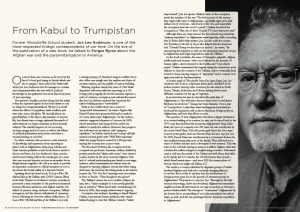
On more than one occasion, as he stood at the bar of a local pub trying to decide which real ale to sample, I have asked New Yorker staff writer Jon Lee Anderson how he manages to contain and compartmentalise the vast well of political knowledge he has gathered over more than forty years of war reporting.
The answer is usually a modest shrug, but the reality is that the ruptured regions he has been drawn to can no longer be compartmentalised. We live in a world where the effects of populism, trade conflicts, and wars echo across the globe. We can talk about our grandchildren or the day-to-day minutiae of normal life, but distant wars or tragic upheaval thousands of miles away are no longer irrelevant to those homely subjects. The real-life impacts on our economy, security, energy, and food costs, as well as the effects of political polarisation and protest, now have a visceral bearing on our lives.
So, when someone who possesses a rich reservoir of knowledge and experience from reporting in places such as Afghanistan, Syria, Iraq, Liberia, and Latin America publishes a new book, there is much to discuss and learn. Jon Lee Anderson’s clear, concise, and focused writing reflects the steady gaze of a man who sees war and injustice not just as anomalies but as deeply human tragedies. His role is as much to provide an important correction to official narratives as it is to document the brutal reality of a fractured world.
Speaking about his latest book, To Lose a War: The Fall and Rise of the Taliban, with CNN’s Clarissa Ward at the Kiln Theatre in Northwest London recently, he presented a stark reminder of the profound mismatch between Western ambitions and Afghan realities. He talked of mission creep, endemic corruption, Taliban resurgence, and the chaotic withdrawal of American forces following an over-two-trillion-dollar fiasco. To Lose a War: The Fall and Rise of the Taliban is not only a searing autopsy of America’s longest conflict, but it also offers rare insight into the realities and chaos of modern warfare, and the pitfalls of nation-building.
Weaving together twenty-five years of New Yorker dispatches with new, reflective reporting on a U.S. foreign policy tragedy, the book’s narrative captures a cycle of violence, corruption, and cultural disconnect that Jon Lee believes rendered the American-led nation-building project “unworkable.”
Early in the conflict there was a sense of “purposeful determinism”, he writes. Figures like Hamid Karzai were promoted abroad as symbols of a new, democratic Afghanistan. On the surface, statistics suggested elements of success: by 2005, school attendance had jumped from under one million to nearly five million. However, this progress was hollowed out by what he calls “gangster capitalism.” In Kabul, warlords and corrupt officials carried out land grabs with “Wild West impunity,” while the poppy harvest soared by 1,500 percent, turning the country into a narco-state.
The disconnect between the occupiers and the occupied was profound. American soldiers, fuelled by protein powder and “alpha male struts,” were viewed as alien entities by the more reserved Afghans. This lack of cultural understanding was literal: in one tragic instance, when humanitarian aid rations were air-dropped to starving Afghans, several died after eating desiccants, the moisture-absorbing packs in the rations, because the “Do Not Eat” warnings were not written in Farsi or Pashto. “They thought it was spices!”
The Taliban’s return was not a sudden collapse, he says, but a “classic example of a successful guerrilla war of attrition.” When faced with overwhelming U.S. forces in 2001, they simply melted away to regroup.
Corruption was endemic. Speaking to Sayed Hamed Gailani, a prominent former politician who stayed behind hoping to steer the Taliban toward a “viable way forward”, Jon Lee quotes Gailani’s view of the corruption inside the machine of the war “The fact is, most of the money that supposedly came to Afghanistan—probably eight and a half dollars out of every ten—went back to the U.S., and meanwhile the corruption here was out of control.” Gailani described the occupation as “like one of those Turkish TV series that never end.”
Although there are many reasons the two-decade-long American “military expedition” in Afghanistan ended ignobly, while conceding that Jo Biden didn’t help matters, Jon Lee also adds the current U.S. President to the list of those who helped fuel the disastrous end. “Donald Trump set this fiasco in motion”, he writes, “by announcing his intention to pull out the remaining American troops in Afghanistan and begin negotiations with the Taliban.”
As the book concludes, the sense of betrayal is palpable. Afghan intellectuals and women—who once believed in the promise of human rights—have returned to the burkha and “iconoclastic purity.” Gailani summarised the tragedy saying the Americans spent trillions to clear the country of the Taliban, only to eventually hand it back to them, leaving a legacy of “ignominy” and a country once again shrouded in fundamentalism.
A former pupil of Woodroffe School in Lyme Regis, Jon Lee Anderson was born to a diplomat father and a children’s book author mother. Among other countries, he was raised in South Korea, Taiwan, Indonesia, and Liberia, having lived in nine different countries by the age of eighteen.
In an interview last year he described the early days of Afghanistan as “the wild place that pot heads went to and James Michener wrote about.” Change has been dramatic. Over a pint of ‘County Best’, I asked him what had happened and what his book and his experience tells us about American foreign policy in Afghanistan, and how that affects us now.
The question of how Afghanistan went from a hippie destination to a country battling to be a nation, he says, can be traced back to the 1973 coup that abolished the monarchy. Afghanistan’s King Zahir Shah, the scion of a dynasty over 250 years old, was overthrown by his cousin Daud Khan. ‘Daoud’s power grab threw the door open to more power grabs, each one bloodier than the last’, says Jon Lee. ‘In 1978, Daoud Khan was overthrown by a Communist faction; he was murdered along with most of his family.’ What followed was a series of further murders and a subsequent Soviet invasion. That war went on for a decade, leaving as many as a million Afghans dead and a further five million refugees in neighbouring countries. ‘Afterwards came a civil war, the arrival of the Taliban and with them, their allies in Al Qaeda; the 9/11 attacks, the US-led invasion that ensued—which lasted twenty years—and since 2021 the current phase of history, which one might call Taliban 2.0.’
The result is a country inhabited by disparate groups of battle-hardened fighters and warlords constantly changing alliances to survive. But is it fair to say then that the involvement of foreign powers gave rise to the growth of extremist groups in Afghanistan? ‘Very much so’, says Jon Lee. ‘Throughout the half-century chronology, I have just described, Afghanistan’s immediate neighbours have all intervened in one way or another, as did major powers further afield. The attempt to “communise” Afghanistan by the Soviets led to an upwelling of not only nationalism but radical Islam, as well. And this was prolonged by the American expedition to Afghanistan.’
While the Taliban are back in power, there is also an extremist offshoot, ISIS Khorasan, that is active along the border with Pakistan, which Jon Lee points out frequently launches ‘murderous sectarian attacks.’ He also highlights a group of “Pakistani Taliban,” which launches terrorist attacks inside Pakistan—a country that once fostered the Afghan Taliban—in the hopes of making that country adopt a more strict form of Islam. The worm keeps turning.’
Nationalism, radical Islam, tribal and warlord factions and the wars that history has beset Afghanistan raise the question of whether it can ever be a “nation”? ‘Alexander the Great, the Mongol Golden Hordes, all have gone through Afghanistan, as did the British three times in the 19th century’, says Jon Lee. ‘It is a long story, and it goes without saying that this has shaped the Afghan temperament. There are allied and rival clans, in some cases with different languages and geographical affinities, and they all form part of the Afghan political mosaic that must be considered by any actor when attempting to rule over the whole country.’ He describes the difficulty as like trying to walk slowly without sinking while walking across quicksand. ‘Perhaps walking through a minefield is a better analogy’ he says.
But does that ‘political mosaic’ make nationhood impossible? ‘This doesn’t mean to say a consolidation of political rule over all of Afghanistan—nationhood—cannot somehow be eventually achieved. But war, not peace, is what comes most naturally to Afghanistan’s political competitors; its attempts at peaceful nation-building have themselves only ever come about through an initial spilling of blood, and never been long-lasting. Right now, the Taliban have managed to prevail over the entire country and seem to hold all the cards, certainly when it comes to coercive power, but they themselves are divided into several internal factions. Will they resolve their internal differences before a new civil war erupts? Time will tell.’
A comment at the Kiln Theatre talk, that it was only a matter of time before there was another war in Afghanistan led to an analysis of how a war should operate. ‘There’s nothing worse that you can do if politics evolves into war,’ he said. ‘It’s about killing people to prevail.’ He suggested that while the Russians understood the importance of complete and ruthless victory, that mindset may not come so easily to the West. I asked him how we should deal with a situation where we are not as prepared to win as they are? ‘War is the most dangerous genie we humans can ever let out of the political bottle, so to speak’ he said. ‘And as Putin has learned in Ukraine, as Hitler learned by invading Russia, and Napoleon before him—it can come back to bite you, and so you should only ever resort to it as the last thing you try. Point being, if you are going to do it, make sure you can win. Otherwise, use every other tool at your disposal before unsheathing your sword. Because the battle you start today in some foreign field may become just the first of many, without a clear outcome, and ultimately be brought and waged in your own home.’
At the time of writing—and let’s face it, we never know what might come from the White House by the time this is published—the Trump administration has Iran, Colombia, and Cuba in its sights, not to mention Greenland. I wanted to know whether Jon Lee believed the increasingly belligerent and aggressive policies that are developing within the U.S. administration are the only future we have to look forward to, or if there is a less tribalist voice wanting to be heard somewhere inside the heart of America?
‘America has a remarkable and well-proven ability to reinvent itself and to restore its lost idealisms’ he explained. ‘Jimmy Carter followed the shame of Watergate and the disastrous retreat from Vietnam of the Nixon years, remember. Barack Obama followed George W. Bush and his calamitous Wars on Terror. Trump is an awful return to the age of Neanderthalism, but hopefully it is a temporary setback.’
Perhaps the mid term elections in November will offer a glimpse into our future. ‘There are American politicians who come from the established political centre and center-left with messages of hope and also with the apparent personal determination to help lead and reset the country, amongst them the Democratic governor of California, Gavin Newsom, and young Democratic congresswoman from New York, Alexandria Ocasio-Cortez. And there are more. The mid-term legislative elections in November of this year will show us which way the country is swinging—whether Trump’s corrupt fever dream has maxed out and is on the wane, or retains the power to entrench itself even further. 2026 will be a fateful year.’
But there is a lot to undo and ‘reset’. Since the shocking exodus of the last remaining U.S. troops, the world has been distracted by other upheavals such as the Russian invasion of Ukraine, Israel’s decimation of Gaza, and, more recently, Donald Trump’s audacious snatching of President Maduro from Venezuela. But what has the impact of the Afghan debacle been on U.S. foreign policy? ‘Trump’s current Stick-then-Carrot approach in Venezuela seems derived from an awareness of the dangers of putting “boots on the ground”, as per Bush and to a degree by Obama,’ suggests Jon Lee. ‘But by using mob-style strong-arm tactics against friendly nations through the threat of tariffs and demeaning language, as he has done with the allies in Western Europe, and takeover talk, as with Canada and Greenland—obviously, there is a lot of damage being done to the international order, with unforeseeable and possibly very dangerous consequences for everyone in the near future.’
Although America’s experience in Afghanistan might appear as much of a failure as its result in Vietnam, there is one exception that has had a keen impact on American society. Vietnam veterans returned to a country that blamed them for the war’s failures, while Afghanistan veterans returned to a country that largely ignored the war’s failures but celebrated their personal service. “Thank you for your service” became a cultural maxim. Today, soldiers often receive priority boarding on planes and discounts at stores, but is that about to change? In his book, Jon Lee talks of Special Forces groups and ‘Wild West’ characters pumped up on steroids, careering around Afghanistan. Assuming not all of these are still in the forces, where are they now? Might we be seeing groups of them wearing ICE uniforms using battle-hardened techniques on their own people? ‘Yes, alarmingly’, answers Jon Lee. ‘There are over three million American men and women alive today who saw combat in the battlefields of Afghanistan and Iraq.’
The wars on terror and other wars, along with the creation of the Department of Homeland Security, have contributed to a ‘palpable paramilitarisation of American culture’, with its proliferation of assault weapons like the infamous AR-15. He also points to the militia groups, the “open-carry” laws—where some states allow people to carry guns without permits—and even the militarisation of many of America’s police forces, ‘some of whom now patrol in military Humvees and other armoured vehicles.’
The parallels between what we saw on the battlefields of Afghanistan and Iraq are stark. Jon Lee also sees ‘a discernible through line between the “Us and Them” rhetoric used by George W Bush in the wars on terror and the anti-migrant “Us and Them” xenophobia and racism that has caught on like a fever amongst Trump’s followers in the United States.’
Where does this leave the American people? Some observers see a foreign policy strategy that has abandoned Afghanistan, Ukraine, Europe, Gaza, and potentially NATO. Donald Trump is gaining control over the appeals judges, the Supreme Court, the DOJ, the FBI, Homeland Security, and Immigration and Customs Enforcement. He also acts as Commander-in-Chief of the American armed forces. Many argue that he is in the process of abandoning the American people by challenging the Constitution. They question whether he is fomenting civil war to gain more control. Jon Lee puts it more concisely: ‘Trump is seeking to install himself at the head of a tyranny, plain and simple, based upon his own cult of personality. If he could rename the USA as Trumpistan, he would.’
To Lose a War: The Fall and Rise of the Taliban
by Jon Lee Anderson.
Published by Fitzcarraldo Editions.
ISBN 9781804272435. RRP£14.99.