



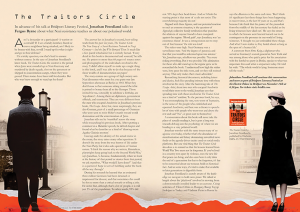
Am I a bystander or a participant? A warrior or a coward? If I see a family member, friend or even a neighbour being attacked, am I likely to be frozen with fear, or will I stand up for what is right and go to their defence?
It’s a tricky question, one that’s hard to answer without context. In the case of Jonathan Freedland’s latest book, The Traitors Circle, the context is the period when Jews were rounded up in Nazi Germany and murdered by death squads, shot on the pavement or shipped to concentration camps, where they were gassed. Their stories have been told for decades. But who was brave enough to stand up for them?
The answer lies in Jonathan’s second, best-selling work from the past six years, The Traitors Circle: The True Story of a Secret Resistance Network in Nazi Germany—And the Spy Who Betrayed Them. It reads like a fast-paced whodunnit but is entirely factual. ‘Every detail in this book is documented and sourced,’ he tells me. He points to more than 60 pages of source notes and photographs of the individuals involved in the story. ‘I didn’t allow myself to make up a single thing in this book, and I was able to do that because of the sheer wealth of documentation on paper.’
The story centres on a group of high-society anti-Nazi dissenters who meet for a tea party one late September afternoon in Berlin in 1943. What they don’t know is that someone sitting around the table is poised to betray them all to the Gestapo. Those invited for tea, ostensibly to celebrate a birthday, are ‘top drawer’. Among them are diplomats, government officials, and countesses. They are very different from the men who escaped Auschwitz in Jonathan’s previous book, The Escape Artist, but, more surprisingly, they are also German, part of a small percentage of Germans who were seen to resist Hitler’s march toward world domination and the extermination of Jews.
Jonathan tells me he ‘stumbled’ across the story while researching his previous book. After spotting a comment in a Himmler speech, he delved deeper and found what he describes as a kind of ‘drawing room Agatha Christie mystery.’
Leaving aside the identity of the actual traitor in the room, the story raises many other questions. It doesn’t shy away from the true horror of life under the Nazi Party, but it also asks questions of human nature. ‘I think the reason why we writers, filmmakers, playwrights keep going back to the Second World War,’ says Jonathan, ‘is because, fundamentally, when we look at the history of that period or stories from that period, we ask ourselves, “What would I have done?” And that is a question I hope is sort of bubbling under the book all the way through.’
During his research he learned that an estimated three million Germans had been detained or imprisoned for dissent, and that sometimes this could be for no more than a critical remark or telling a joke. He notes that, although that’s a lot of people, it is still just 5% of the population. ‘In other words, 95% did not. 95% kept their head down. And so I think the starting point is that most of us do not resist. The overwhelming majority do not.’
Aligned with these figures, and our potential reaction to such an extreme situation, is the question of Sippenhaft, collective family retribution that punishes the relatives of anyone found to have conspired against the regime. ‘Blood guilt’, says Jonathan, was ‘an enormous threat’. It was a strong reason not to step out of line because ‘the risk was total.’
The stakes were high. Nazi Germany was a surveillance state. ‘And the degree of paranoia and fear that you would be informed upon was intense.’ Yet, Jonathan says, rebellion was possible. ‘You were risking everything. But it was possible.’ His admiration for those who did stand up to the regime grew as he researched the book. ‘I understand how high the stakes were, how great the risks were, and yet they still resisted anyway. That only makes them more admirable.’
Researching historical documents, including letters and diaries, feels like spending intimate time with those involved in the story. After the harrowing tale of The Escape Artist, about two men who escaped Auschwitz to tell their story to the world, Jonathan says that spending time with those involved in The Traitors Circle was a kind of ‘antidote.’ In the previous book, he says, ‘I was contemplating the very, very worst of humanity, in the sense of the people who established and operated Auschwitz, and here was a chance to spend a lot of time with people who went over and above the rest and said “No”, at great cost to themselves.’
A conversation about this book will never take the place of actually reading it, but it goes a long way towards delving into the psychology of where we are heading in a very polarised world.
Jonathan wrestles with the same issues many of us agonise over today, whether that’s the abundance of misinformation and fakery dominating unverified news feeds or the agenda-driven tactics used on social media platforms. But one vital thing that The Traitors Circle also does is to remind us that the lessons learned from World War Two must not be forgotten. If you’ve lived in a country torn apart by violence, seen the new life that peace can bring, and also seen how it only takes the end of a generation for that to be forgotten, it’s fair to be concerned about our tenuous hold on historical fact. And in some ways, it’s vital to make that available to later generations in digestible form.
Jonathan Freedland is acutely aware of the knife-edge we navigate to hold onto peace. We talked at length about the ‘playbook’ involved in moving from a democratically installed leader to an autocrat. Citing activities of Viktor Orbán in Hungary, Recep Tayyip Erdoğan in Turkey and Vladimir Putin in Russia he says the dilemma is the same each time. ‘But I think it’s significant that these things have been happening in recent times, in the last 10 years or so, and that’s because I do think that the power of the precedent from the middle of the last century has faded as the living witnesses have died out.’ He says the extent to which the lessons were learned turned out to be contingent on the presence in our world of living witnesses. ‘I thought we just embedded these things. And what I now realise is, they lasted about as long as the span of a human life.’
A comment from Otto Keip, a diplomat who served as Germany’s consul general in New York and was among those who paid a price for his association with the fateful tea party in Berlin, speaks to what was important then and what is important today. He told his wife: “The whole world is lying. Someone must tell the truth.”
Johnathan Freedland will continue this conversation and more as part of Bridport Literary Festival at the Electric Palace in Bridport on November 14th at 6.30 pm. For tickets visit: bridlit.com.