



A Short History of America: From Tea Party to Trump by Simon Jenkins
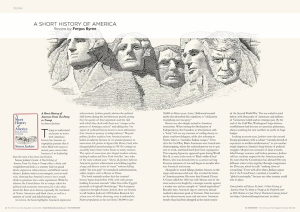
Trying to understand and come to terms with American history has become an unpopular pastime that is often filled with angst in recent years, more often because of its leadership than the wars it has been involved in.
Simon Jenkins’s book A Short History of America: From Tea Party to Trump offers a lively and straightforward look at a country built on grand ideals, impressive achievements, and difficult moral choices. Jenkins writes in an energetic, easy-to-read style, showing that America’s story is not a steady climb to greatness but a risky experiment. While he admires the United States for its unique talent for political and economic innovation, he is also clear about the flaws in its history, especially the treatment of Native Americans and black slaves, as well as a number of costly and failed foreign wars.
At its best, the book highlights America’s impressive achievements. Jenkins greatly admires the political skill shown during the revolutionary period, noting that the quality of their arguments and the skill with which they dealt with them was “unique in the process of forming a nation” and adding that “no aspect of political history deserves more admiration than America’s journey to independence.” Beyond politics, Jenkins explains how America became a leader in industry because of its special openness to innovation. He points to figures like Henry Ford, who changed global manufacturing in 1913 by cutting car assembly times from twelve hours to ninety minutes. This spirit of innovation also shaped modern culture, making London and New York look like “two sides of the same cultural coin.” Above all, Jenkins believes America’s greatest achievement was holding together a large and diverse union of states” without falling under “the iron grip” of centralised authoritarianism, unlike empires such as Russia or China.
The book reminds readers that the country’s history began long before 1492, with early groups building Louisiana mounds “older than either Egypt’s pyramids or England’s Stonehenge.” But European expansion brought disaster. Jenkins does not hesitate to call Andrew Jackson’s 1830 Indian Removal Act a clear case of ethnic cleansing, since it reduced the Native population in the east from 130,000 to just 30,000 in fifteen years. Later, Hollywood created myths that described this expulsion as “civilization triumphing over savagery.”
Slavery was also deeply rooted in American institutions. When writing the Declaration of Independence, the Founders, in what Jenkins calls a “funk,” left out any mention of ending slavery to please southern delegates, while also referring to Native tribes as “merciless Indian savages.” Even after the Civil War, Black Americans were forced into sharecropping, where the enslaved person was to pay rent to work, and faced harsh Jim Crow segregation. This ongoing hypocrisy appeared again during World War II, as seen in the story of Black soldier Lloyd Brown, who was denied entry to a canteen serving German prisoners of war and began to wonder who was America’s real enemy.
Alongside its moral failings, Jenkins focuses on the tragic and unsuccessful wars that revealed the limits of American power. He notes that General Ulysses S. Grant called the 1846 war with Mexico one of the most unjust ever fought by a stronger country against a weaker one and an example of “naked imperialism.” Decades later, America’s urge to intervene abroad reached a disastrous peak in Vietnam. That war went on for almost twenty years and saw more American bombs than had been dropped in the entire course of the Second World War. The war ended in total defeat, with thousands of Americans and millions of Vietnamese killed and no strategic gain. By the end of the Cold War, Washington’s large defence establishment had become an uncertain policeman, always searching for new conflicts to justify its huge budget.
Looking at recent years, Jenkins views the second Trump presidency, with a cabinet “virtually devoid of experience or intellectual distinction,” as just another tough chapter in America’s long history of political struggles. Despite two centuries of deep wounds, failed foreign ventures, and broken promises, Jenkins still has a realistic respect for the American project. He notes that the Constitution has allowed fifty very different states to live together through compromise for 250 years, which he calls “nothing short of astonishing.” Even with all its flaws, Jenkins argues that if the United States vanished, it would be a “global catastrophe,” because no other country could take its place.
Simon Jenkins will discuss his book A Short History of America: From Tea Party to Trump at the Dorford Centre on 24th October at 2 pm. Part of Dorchester Literary festival visit https://dorchesterliteraryfestival.com/ for tickets.