



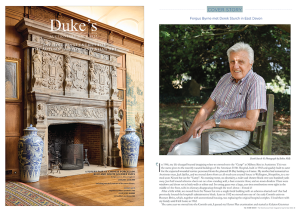
‘In 1946, my life changed beyond imagining when we moved onto the “Camp” at Millwey Rise in Axminster. This was the name given to the recently vacated buildings of the American 315th Hospital, built in 1943 and quickly built to cater for the expected wounded service personnel from the planned D-Day landings in France. My mother had remarried an Axminster man, Jack Spiller, and we moved down from an all-mod-cons council house in Wellington, Shropshire, to a no-mod-cons Nissen hut on the “Camp”. No running water, no electricity, a toilet and shower block over one hundred yards away. Just half-round asbestos sheets set on a low-standing wall, a bare concrete floor, and no room dividers. There were windows and doors set in brick walls at either end. Its saving grace was a large, cast-iron combustion stove right in the middle of the floor, with its chimney disappearing through the roof above—I loved it!
After a little while, we moved from the Nissen hut into a single-brick building with an asbestos-sheeted roof that had previously housed the hospital’s administrative block. Later in 1952 we moved into one of the early Cornish units on Bonners Drive, which, together with conventional housing, was replacing the original hospital complex. I lived there with my family until I left home in 1962.
The same year we moved into the Cornish unit, I passed my Eleven Plus examination and started at Colyton Grammar School. I look back on those years with fond memories, but no academic achievements to show for it. There were only two things that interested me—football and cricket—for which I always represented the school’s teams. My ‘O’ levels were a disaster. I sat English Language twice and failed both times. I made up my mind to leave and at 17 felt I was a burden on my parents. There was a hurried shaking of hands on the final day, which I think was a Wednesday.
The following Monday morning, I climbed aboard a Southern National double-decker and headed for Chard. There I visited all the factories in the town, looking for jobs. I’d virtually given up hope until I called into Denings. There I met the gateman, Frank Radford, who rang Terry Dolling to enquire on my behalf. Five minutes later I was interviewed; another five minutes and I had a job as a sales assistant to Cecil Collins at £3-16-4d a week. Not bad; I’d left school on Wednesday with no idea of what I wanted to do, and by three o’clock on Monday I had a job!
I worked at Denings for two happy years, then at a farm for a while before getting a job with Dorset Farmers at their machinery depot in Broadmayne. I was assistant to the sales manager, Bob Dandy, selling Massey Ferguson tractors and associated machinery. I remember the new MF 35X tractor being introduced, which then cost £425! Shortly after, the revolutionary muck spreader, the ‘Howard Rotaspreader’, became available. Dorset Farmers was then rebranded as South Western Farmers when they absorbed East Devon Farmers and created a machinery depot at Crediton. They offered me the opportunity to become their first machinery rep in East Devon, which I accepted.
I spent a couple of years with them before being seduced by Bell & Sons from Huyton, with ten pounds a week plus a ten per cent commission if I sold £100 worth of their animal health products in a week. Their then area manager, Denis Brinicombe, accompanied me for the first few days to show me how easy it was. The following week, when I was set free by myself, I found that we’d called on all the customers who were due to reorder, so I had to begin from scratch. Luckily, I was covering the same area as I had done selling machinery, so I soon opened up a brand-new customer base.
The company went through six takeovers during my working life, and I was lucky enough to take advantage of each one, travelling to many countries in the process.
My working life came full circle when our last owner, Tate and Lyle, decided it was time to sell us off. By then I was National Sales Manager and was part of the team that made several presentations to sell the company. One day I called into Denis Brinicombe’s offices. Denis, since leaving Bell and Sons, had built a successful company manufacturing and selling animal nutrition products. While we were chatting, I told him about the sale and who to contact. He said he was interested, but only if I would join him for two years to settle the two sales forces in. This meant persuading representatives to give up both territory and customers. From the experiences that followed, I would advise anyone against attempting it. I did succeed in the end and decided that it would be my swan song.
Looking back, the highlight of my 35 years with the company was chatting with Prince Charles at the Duchy Home Farm in Cornwall before he met Princess Diana. The scariest moment was manning the company stand at the Smithfield Show in London during the IRA bombing campaign, hearing the coded warning messages coming over the tannoy.
I consider myself very lucky to have visited many countries during my employment. In Finland, I became so inebriated on the boat to the company’s island in the Baltic that I had to be smuggled past the welcoming assembly of Directors and hidden under dense shrubbery to sleep it off until the following morning. A sauna and a dip in the Baltic sort of cured my hangover. We were also there just after the Chernobyl nuclear reactor exploded, and we had to be continually tested for radiation poisoning. In Chicago, we took planes like taxis, flying hundreds of miles and coming back the same day. We did once stop over at Nashville, and in the hotel we were booked into, there was a country music festival taking place, and nobody went to bed. If you did, you didn’t sleep. So many stories! I must write a book.
Which brings me on to writing. I’ve always enjoyed putting lines together, and after I retired, I released several poetry books, mainly in rhyming and rhythmic forms. I’m not a blank verse writer. The books then became a mixture of poetry, prose, and even cartoons. A Squatter’s Write about the “Camp” at Millwey Rise, and Brexshhit are examples of this.
I’ve had my words regularly printed in various newspapers and magazines. In the early months of 2025, I decided I needed to set down the many anecdotes and stories I had heard about our family. The first book of the trilogy, In Golden Cap’s Shadow, could be described as anecdotal fiction and lays the foundation. It portrays the hardships of my stepfather’s family’s early life at Westhay, which lies between the folds of Stonebarrow Hill and Golden Cap, close to the remains of Stanton St. Gabriel. It follows the family’s nomadic travels through West Dorset, especially the beautiful Marshwood Vale, before they eventually settle in Thorncombe.
The second novel, Golden Cap’s Glory, has yet to be released and is entirely fiction. It is my own interpretation of what my stepfather could have achieved with the many attributes he had. To me, he was so frustrating; he made a successful career, beginning as a storeman and then rising to become the company’s top-selling representative. The only thing that held him back from progressing any further was that he “knew his place” in life, and he deferred to anyone he believed was of a higher standing than himself. I’ve set that straight; in my novels he certainly makes the most of all his attributes and rarely bows to anyone.’