



This month featuring Margaret Preuss Higham
Celtic saints often described a place where the atmosphere made it easier to connect with God as a ‘thin place’. For former hairdresser, retired priest and photographer Margaret Preuss Higham, that place is the Dorset coast. It can be a place where the noise of the world falls away and one can contemplate the quiet shifting waves and sands, perhaps connecting the spiritual with the spectacular natural world we live in.
Margaret’s life has been punctuated by remarkable transitions. For decades, she was a mobile hairdresser, travelling from house to house around Bridport, listening to local residents’ life stories. At 51 she submitted to God’s call to become a priest, ultimately serving as vicar of three coastal parishes. Now, having officially retired, she has stepped into a new calling: capturing the fleeting beauty of the world through the lens of a camera.
‘I started work as a hairdresser when I was 16, and I didn’t stop until 2020,’ Margaret tells me. She wryly recalls politician Edwina Currie once suggesting that those who weren’t “very clever” could always fall back on hairdressing—Margaret found the work deeply fulfilling. Yet a deeper, spiritual calling had lingered since childhood.
‘I remember I announced to one of my school teachers that I was going to be a missionary when I was ten years old,’ Margaret laughs.
However, it wasn’t until her father was diagnosed with terminal cancer and expressed a wish to return to church that Margaret began accompanying him to St Swithin’s Church in Bridport. Over the years, as she taught Sunday school and served on the parish council, she decided to train as a vicar.
It was a huge challenge. Having left school at 16 with no degree, the academic side of theological training was daunting, particularly as Margaret suspects she is dyslexic. ‘The church turned me down to start off with because of my lack of education,’ she admits. ‘They are still quite academic.’ But her local priest, Trevor Stubbs, believed in her. He persuaded the bishop to let her begin. ‘On my 52nd birthday, my training officer knocked on my front door and gave me a thumbs-up.’
In time, she took on leadership of three parishes. It was the move to the picturesque village of Portesham that reignited her interest in photography.
‘Time for the last 12 years had been quite busy,’ Margaret says, ‘looking after three churches and still hairdressing.’ But there were times when she could go out to the Fleet at Langton Herring with a passage from the Bible in her head and find her thin place. It became her sanctuary. If she had a challenging sermon to write, or had just conducted a funeral and needed space to decompress, she would wander down to the water’s edge to listen to the birds.
‘Seeing the light drop over the Fleet, the reflections in the water, the clouds, and the light shining right over to Golden Cap—it moved me.’ Those same reflections can now be seen in her photography as it has developed.
Her father had been a passionate amateur photographer and a frequent visitor to Pinns, the legendary camera shop in Bridport. Margaret still treasures a photograph of herself as a toddler, clutching her father’s camera bag at London Zoo. But it was a local exhibition organised by the Friends of Portesham Church that prompted her to share her work. Though she entered with trepidation, the experience introduced her to members of the Bridport Camera Club, an organisation she credits with completely transforming her understanding of ‘light, shape, and form.’
For Margaret, photography is more of an active, experimental conversation with nature rather than chasing traditional landscapes. These days, she is drawn to the abstract, the textured, and the overlooked.
One of her favourite techniques is Intentional Camera Movement (ICM). In one striking image of silver birches, she used a slow shutter speed to turn the trees into streaks of liquid silver against a vibrant backdrop of gorse.
In another photograph of a sunset, she set her camera to bulb mode and physically moved the camera to draw shapes in the night sky. ‘I wiggled it around, drawing shapes like an artist with a paintbrush,’ she explains.
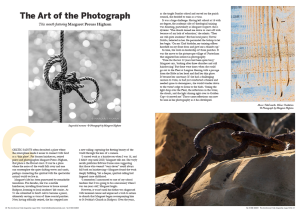
Her curiosity extends to the smallest details: the mathematical parallel lines on a tumbled stone at Westward Ho!; the deep, salty texture of a knotted harbour rope in Cornwall, captured with a shallow depth of field; or the simple, evocative shape of a lone footprint left on a wet beach.
She is also fascinated by rust. ‘Rust is about metal starting in its raw form in the ground,’ she explains. ‘Man processes it, shapes it, uses it to moor a boat, and over time nature gradually takes it back. It’s the story behind the image that informs why I take the photograph.’
Although officially retired from active ministry, Margaret finds that the roles of priest and photographer are inextricably linked. Both require a willingness to slow down, pay attention, and look beneath the surface. ‘I feel very close to God when I’m on the beach,’ she says, describing the coast as her ultimate ‘thin place.’ She often writes poetry to accompany her images, weaving the two mediums together to express her gratitude for the natural world.
Her retirement promises to be anything but quiet. Alongside upcoming exhibitions with the Bridport Camera Club and local artist groups, she is planning a book that combines her photographs of Portland with her personal poetry and reflections, and she is also going through an archive of slides from a trip to the Holy Land.
She is also hoping to collaborate on an ambitious, community-led eco-art installation. Inspired by the environmental work of photographer Mandy Barker, Margaret wants to create an installation that highlights the significant impact of plastic. ‘It’s about loving the planet,’ she says, ‘highlighting our responsibility to look after the created world.’
From snipping golden locks to the quiet solemnity of the pulpit, the creative freedom of the lens is enabling Margaret Preuss-Higham to continue a journey of exploration grounded in spiritual reflection.
Look for her work at the Bridport Camera Club exhibition on 19th September at Bridport Town Hall, or at The Dorset Monochrome Collective exhibition at Borough Garden House Community Room in Dorchester from 14th to 20th September.
Margaret’s blog is at: https://margarethigham.wordpress.com.