



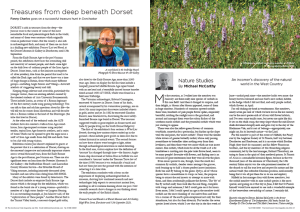
My first reaction, as I walked into the meadow, was curiosity: are there really nine species of orchids in this one field? And then it changed to surprise, and then delight, as bloom after bloom appeared, some of them in huge numbers. Hundreds of common spotted orchids there were, hundreds of pale purple flower spikes, exquisitely beautiful, catching the sunlight across the grassland, and around and amongst them were the colour flashes of the southern marsh orchids and the pyramidal orchids which were just starting to appear.
There were also the yellow-green flowers of common twayblade, somewhat less spectacular, but further up the slope were the real prizes, the ‘insect orchids’. There were the slender white towers of greater butterfly orchid, whose only passing resemblance to butterflies takes nothing away from their loveliness; and then there were two more which are true insect mimics. Bee orchids, which look for all the world as if a fat bumblebee is crawling into the pale violet flower head, seem to be many people’s favourite wild flowers, and finding one is an occasion of great excitement; here they were all over the place.
Even more special to me, though, were the much less common fly orchids, slender stems amongst the grasses, each bearing up to half a dozen perfect insect imitations. Both bee and fly belong to the genus Ophrys, all of whose species have a resemblance to wasps or bees, the purpose being to attract the real insects to attempt to mate with them, and then accidentally pollinate the flowers. The ‘fly’ of the fly orchid really does look like the real thing, complete with wings and antennae; I felt I could gaze on it for hours. Even more, I felt I could spend an age in the meadow itself: orchids are the most dazzling of our native flora and here was a corner of the earth quite exceptional not only for their abundance, but also for their diversity. For besides the seven species listed above, which I saw that day in the first week of June—orchid peak time—the meadow holds two more: the honey-brown-coloured and rare bird’s nest orchid, hidden in the hedge which I did not find, and early purple orchid, which flowers in April.
I’m still shaking my head in wonderment. Hay meadows, ninety-seven per cent of which we have lost in the last century, can be the most species-rich of all our wild flower habitats, and I’ve seen some terrific ones, but never one quite like this. It sits on the chalk scarp, the steep slope where the mid-Dorset chalk downland abruptly ends and gives way to the clay of the Blackmore Vale, and it sort of belongs—appropriately, one might say, for its heavenly nature—to the Lord.
For the meadow is part of the estate of Hilfield, the Friary run by the Anglican Society of St Francis, half way between Dorchester and Sherborne; and it is an estate which Brother Hugh (they don’t do surnames) and his fellow Franciscan brothers, and the lay members of this flourishing religious community, led by the land manager, Richard Thornbury, are trying to farm in the spirit of their medieval patron. St Francis of Assisi is a remarkable historical figure, because in the two thousand years of the existence of Christianity, the 13th century Italian mystic was the sole prominent member of the church to call for true love and respect for nature and the natural world (the orthodox Christian position, until recently, being that it was all put there for us to use and exploit.)
Hilfield in fact manages four wild flower meadows, but the orchid meadow with its nine orchid species is the most special, and gazing on it that day in June, I felt that St Francis himself would have rejoiced to see such a wonderful example of the benevolent stewardship of nature. I certainly did.