



At the Harmony Centre in Bridport, Fergus Byrne finds out how a mental health drop-in centre is using creativity to build community and trust without judgment.
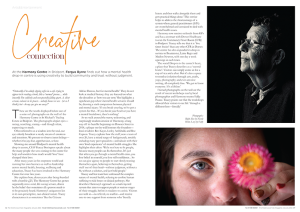
“Outwardly, I’m calmly sipping coffee in a café, trying to appear to be reading a book, like a ‘normal’ person… while inwardly I’m suddenly and unexpectedly falling apart. A silent scream, volcanic in its power, – nobody knows or sees – (or so I think); but – do my eyes give me away?”
These are the words displayed below one of a series of photographs on the wall of the Harmony Centre in St Michael’s Trading Estate in Bridport. The photographs depict eyes—seeing, searching, staring—and though silent, expressing so much.
Often referred to as a window into the soul, our eyes silently broadcast a steady stream of emotions and intentions. We present or observe inner feelings—whether it be joy, fear, apprehension, or love.
Showing me around Bridport’s mental health drop-in centre, CEO Tracey Bovington speaks about the many people she sees coming to the centre for help and wonders how much would ‘love’ have changed their lives.
After many years in the corporate world and running her own business as well as leadership across mental health, housing, wellbeing and education, Tracey has been involved in the Harmony Centre for over two years.
She explains how, eleven years after being founded with a humble £25, The Harmony Centre has grown organically into a vital, life-saving service, driven by the belief that sometimes all a person needs is to be genuinely heard. Harmony’s uniqueness lies in its non-prescriptive, non-clinical nature. Tracey characterises it as sometimes ‘like the Citizens Advice Bureau, but for mental health.’ They do not look at medical history; they are focused on what she describes as ‘how you are now.’ She highlights a significant gap where mental health services should be, drawing a stark comparison between physical and mental injury: ‘If you break your leg, we’ve got a system for that… If you break your heart or you have a mental breakdown, there’s nothing.’
As we walk around the warm, welcoming, and surprisingly modern interior of Harmony, a long way off its humble beginnings in Downes Street in 2014, a plaque on the wall honours the founders—local residents Ros Kayes, Lesley Archibald, and Roz Copson. Tracey explains how the staff, now a team of over 20, have a mixed range of backgrounds, notably including many peer specialists—individuals with their own ‘lived experience’ of mental health struggles. She highlights their ethos: ‘We’re not here to fix people, because many people can fix themselves. It’s just that when you go through a mental health crisis, you lose belief in yourself, you lose self-confidence… So we can give agency to people to start slowly trusting themselves again, believing in themselves, getting stuff out of their head—without judgment, without a fit, without a solution, and just hold people.’
Tracey and her team have embraced the complex nature of mental health, refusing to confine human suffering to tick-boxes or clinical pathways. She describes Harmony’s approach as a multi-layered system that aims to support people at various stages of their struggle, before it escalates to a crisis. Visitors can walk in—no referral, no waitlist—and receive one-to-one support from someone who ‘literally listens and then walks alongside them and gets practical things done.’ This service helps to address the shortcomings of a system where general practitioners (GPs) are overwhelmed and untrained to deal with mental health issues.
Harmony now receives referrals from GPs and has a contract with Dorset Healthcare to run the Community Front Room (CFR) in Bridport. Tracey tells me that it is ‘five times busier’ than any other CFR in Dorset. The centre has also expanded its drop-in service to Beaminster, Lyme Regis and Maiden Newton, with one day a week openings in each town.
The social Drop-in is the centre’s heart, a place that Tracey describes as a ‘second home’. Visitors can simply come in for a cup of tea and a chat. But it’s also a space to combat isolation through arts, crafts, yoga, photography and even creative writing, all completely free. ‘We get to know everyone. It’s a lifeline.’
Framed photographs on the wall are the result of recent workshops run by local photographer and Harmony trustee Eddy Pearce. Tracey points out that the workshops allowed their visitors to see life ‘through a different lens—literally.’
Eddy explained that the workshops explored how photography might be used ‘mindfully’. In recent years, he told me, he has become ‘increasingly fascinated’ with how photography, particularly portraiture, can work as a tool to both explore and create community and connection. ‘At its most basic level’ he says, ‘a connection clearly exists between the person taking a photo and the subject of that photo.’ He went on to explain how ‘the Harmony workshops have been a life-affirming example of how photography as a shared activity develops trust and relationships within the group, and how a sense of community or belonging can be revealed when a lens is focused on an immediately local and familiar world.’ But when you ‘dig deeper’, he says, ‘it is clear that the most meaningful photography comes not from a fancy camera, or learning about composition or apertures, but from when whoever is taking the photo allows themselves to be fully mindful and lost in the moment.’ In the context of a mental health environment, he says, ‘that is real gold.’
That real gold shows through in the photographs taken by the visitors. ‘It has been a joy to run these sessions, and to see creativity and confidence grow side by side. The participants have been total stars and I know are super proud of the results!’
Another local photographer, Jon North, who also assisted with the workshops, described photography as offering an opportunity ‘to pause and notice the beauty in the small, everyday details that often go unseen’. Working with the Harmony visitors, Jon said it was wonderful ‘to see others discover the same sense of calm, creativity and connection through these workshops.’
Visitors who took part in the workshops, such as Heidi, penned their experiences. Heidi wrote: ‘Photography gave me a sense of purpose and helped me realise that I am more than just a mental health condition or label!’
Gordon, who talked about the ‘positive aspect of socialisation’ and group discussions, explained that ‘Creativity can be deeply personal’ and although often inspired by others, he added that ‘just a little validation or encouragement can work wonders with someone’s self-esteem and confidence.’
Other visitors who took part in the workshops, such as Lily, Dave, and Juliet, all highlighted how working in a group helped them develop a deeper connection not only with the world around them but also with their community and one another.
Lucy also emphasised how the workshops provided ‘a sense of purpose, a reason to step outside and simply be’. She said photography ‘teaches us patience, resilience, and the courage to see the world, and ourselves, from a fresh perspective.’
Ros, whose words open this article, admits that she has tried everything to help with her mental health issues but found mindful photography to be ‘transformative’. Using the camera on her phone, she says, enhances her ‘sense of wellbeing’ and she highlights the enormous benefit of ‘no side effects!’
Tracey hopes a selection of images from the project can reach out to the town by becoming part of an initiative working with local business owners. Looking ahead, she hopes to develop a ‘mentally aware area’ through a ‘Community Connectors’ project. This initiative aims to inspire and support local businesses to become mental health ambassadors who can simply say, ‘Have you heard about Harmony?’ This approach shifts the responsibility of seeking help and eases the pressure by asking straightforward, non-judgmental questions.
Ultimately, Tracey is guided by a simple, profound question, one we mentioned earlier: ‘What would love do here?’ It’s a powerful ethos that supports the entire operation, recognising the harsh reality that people don’t have to be ‘progressing’ to deserve to live.
Tracey and the Harmony Centre are not just helping people through crises; they are advocating for the right to safety, connection, and non-judgmental acceptance—a true lifeline in a system that often fails to prevent heartbreak.
To learn more about the Harmony Centre visit: www.theharmonycentre.org.uk. Harmony is currently looking for two new Trustees. For more information and to arrange an informal chat please email the Chair: rachel.c@theharmonycentre.org.uk.