



Rewilding the future, not the past
Dr Sam Rose addresses the elephant in the room
When talking about rewilding I often encounter the perception that the practice is trying to replicate the past… to recreate a landscape that existed before pesky old homo-sapiens settled down and messed things up. To be honest, in the UK and Europe we are really only talking about 5-10,000 years ago, after the last ice age, which is a mere microsecond in the ticktock of the geological clock. During this period, it seems most likely that the UK was covered with a wood pasture-like mosaic of forests and glades (although this is disputed by some ecologists) alongside closed canopy woodlands, wetlands and meadows, and populated by a lot of free roaming large herbivores and predators.
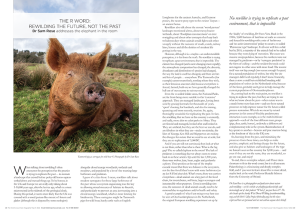
I guess it’s a fair shout. I mean, rewilders talk about modern surrogates for those large herbivores of the past whose ecosystem engineering was the key to allowing mixed mosaics of habitats to flourish, and particularly to prevent an area just turning into a closed canopy woodland, which is more limiting for biodiversity. These surrogates might be Tamworth pigs for wild boar, hardy cattle such as English Longhorns for the ancient Aurochs, and Exmoor ponies, the nearest pony-type to the extinct Tarpan—an ancient horse.
Rewilders also talk about the mosaic ‘wood pasture’ landscape mentioned above, about messy beaver wetlands, about ‘floodplain reconnections’ or river rewiggling and about other concepts that harp back to halcyon days when animals could fight each other savagely without the nuisance of roads, canals, railway lines, houses and all the detritus of modern life getting in the way.
However, although it is—maybe—an understandable perception, it is far from the truth. No rewilder is trying to replicate a past environment, that is impossible. The climate has changed (and is now changing more rapidly), the atmospheric composition has changed, the diversity, abundance and distribution of species had changed, the way the land is used has changed, and there are lots and lots of people… everywhere. The Tamworths (for example) cannot roam freely, rootling where they wish, as their ferocious ancestors did, because everywhere is fenced, farmed, built on; we have generally changed the hell out of our country to suit our needs.
Even the so-called wilder areas, the National Parks, are far from being more suitable to this ‘extensive’ approach. They are managed landscapes, having been used by grazing livestock for thousands of years, ‘sport’ shooting for hundreds, and also for mining, quarrying and more recently, tourism. So, again, thoroughly unsuitable for replicating the past. In fact, the rewilding that we have in this country is currently, and sadly, more akin to safari parks in Africa. They are fenced and managed, looked after and looked at. They are artificial, but they are the best we can do, and are fabulous in what they are—make no mistake, the likes of Knepp, Ken Hill and Mapperton are making the changes for nature that we need to see at scale, but they are no replication of 5,000BC.
And if you are still not convinced, then look at what is not there, rather than what is there. What is the big gap? The so-called elephant in the room? The lack of predators is something that we always seem to come back to in these articles. Up until the last 1,500 years, there were wolves, lynx, bears, eagles and goshawks a-plenty. Their position at the top of the trophic cascade meant that there was balance in the ecosystem, not the free-for-all there’s now with some herbivores (see my last R-Word about deer). What’s more, there was carrion everywhere—dead animals are a key part of the food chain, for invertebrates, soil biota, larger scavengers and innumerable other purposes. Even in rewilding sites now, the carcasses of dead animals usually need to be removed due to regulations and/or health and safety.
A good example of what I am trying to say here can be seen at Oostvaardersplassen in the Netherlands, the original European rewilding experiment set up by the ‘daddy’ of rewilding, Dr Frans Vera. Back in the 1980s, 5,600 hectares of land was set aside as a reserve and fenced for rewilding with a mix of herbivores and ‘no active intervention’ policy to create a so-called ‘Pleistocene type’ landscape. It all went well for a while but by 2018, a majority of the animals had to be culled because they were dying of starvation. The cause was massive overpopulation, because the numbers were not managed by predators—or by ‘surrogate predation’ in the form of culling—and the resident livestock could not migrate to other areas with more food. The reserve itself was not big enough (nor secure enough I expect) for a natural population of wolves, but why the site managers didn’t cull regularly, I don’t know. Ironically, there is now a small but established breeding wild population of wolves in the Netherlands who, because of the fence, probably can’t get in to help manage the current population of Oostvaardersplassen.
So, coming back to the main point, no rewilder is trying to replicate the past, but they are trying to use what we know about the past—when nature was in a much better state than now—and use those natural processes to help improve nature for the future; called process restoration. What do we mean by natural processes in this context? Healthy predator-prey interaction is one example, as is the multi-herbivore approach—each of the four different main groups (pigs, deer, cattle, horses), undertake a different and complementary role in the system. Reintroduction of key species is another—beavers and pine martens being at the forefront of this in the UK now.
So, learning from the past, and mimicking the processes from those times, can help us make positive, emphatic and lasting change for the future, and also give us habitats and landscapes of the type we haven’t seen in this country for 5,000 years… and even if they are not the same, they are wonderful, so go see one, and enjoy!
To end, this is a complex subject, and I have taken shortcuts to fit in the word count, but it is all accurate. Palaeobiology is a fascinating and deeply complex field, and if you want to learn about this in more detail, maybe look at the work Professor Danielle Schreve from the University of Bristol.
Dr Sam Rose is a photographer and podcaster about nature and rewilding—see his website at whatifyoujustleaveit.info and increasingly out of date podcast “What if you just leave it?”. He also heads up the charity West Dorset Wilding (westdorsetwilding.org) and the Brit Valley Project (britvalley.org) but the views expressed here are personal and are not said on anyone else’s behalf.