



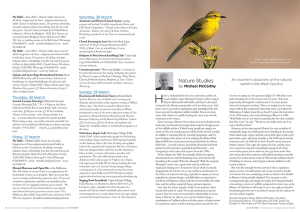
Here’s a melancholy list for you: turtle dove; willow tit; wood warbler; snipe; Montagu’s harrier; yellow wagtail. They’re all beautiful wild birds, and they’ve all ceased to breed in the Dorset countryside in the last forty years. And here’s a list to go with it: nightingale; grey partridge; little owl; lesser-spotted woodpecker; willow warbler. Those are more super birds which are rapidly heading the same way, towards extinction in the county.
Since moving to Dorset I have taken ever more delight in the landscape, but found increasingly distressing the disappearance of the wildlife within it. I think many people are simply not aware of this, for a landscape can still be lovely to look at while its wildlife is vanishing. But it’s certainly happening, and I’ve been looking at the proof of it by studying the Dorset Bird Report 2024, the annual assessment produced by the Dorset Bird Club – a terrific volume, beautifully illustrated with bird photos by club members, published last December – and comparing it with earlier club reports from the 1980s.
In the volume for 1986, for example, all the lost species mentioned above, and the declining ones, were shown still breeding in the county. What has changed? Well, the exquisite Montagu’s harrier was a great rarity anyway, with just a single pair clinging on in Cranborne Chase which eventually disappeared, but for the rest, it may well be a combination of the effects of intensive farming, especially in wiping out insect populations, climate change, and difficulties on migration to and from sub-Saharan Africa, with the wood warbler, the turtle dove and the yellow wagtail all being summer migrants.
Let’s take the yellow wagtail, a bird of wet pastures, often found with herds of cattle. Not really celebrated; no poems about it that I’m aware of; non-birders will probably not even know it. But let me tell you, it is just the loveliest thing, a combination of brilliant yellow and olive green, a flying version of a primrose, and to watch it chasing insects around the feet of cows in spring was the greatest delight. In 1986 there were pairs breeding across the county; now it’s gone. But more importantly, although less understood: it’s not just species that we’re losing, it’s numbers. There are simply fewer of many many birds in the countryside than there were, say, before the Millennium. I talked about this to Geoff Upton, the lead editor of the 2024 report, who started birding in Dorset in 1988. “Wild birds are just not there in anything like the same numbers that they were,” he said. “The losses are really, really sad. I try not to dwell on them.”
However, in the same period, Dorset has seen an influx of remarkable, large, new bird species now breeding in the county: white-tailed eagle, osprey, red kite, raven, little egret, cattle egret, great white egret, and most recently, as the 2024 report reveals, common crane. In 1986 all of these (bar the raven) were just birders’ dreams. The eagle, the osprey, the kite and the crane have arrived via national reintroduction projects; the three snow-white egrets, heron-relatives, have got here under their own steam from the continent, with global warming a possible reason. I’ve written about some of them in this column; they’re all thrilling to observe, and a hugely welcome addition to the county avifauna.
But I do feel strongly that the arrival of these superlative species (some, it should noted, only in tiny numbers) should not obscure the true, underlying situation, which is that birdlife in Dorset is being steadily depleted. You can gaze on the stunning landscape and simply not realise how impoverished it is becoming in terms of wildlife, compared to what it was in the lifetime of bird-lovers still living. To see a sea eagle overhead is breathtaking; but for me it just doesn’t cancel out the sadness of no more yellow wagtails.