



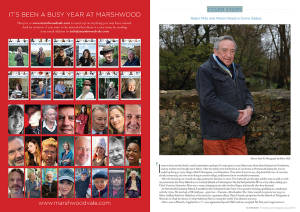
Robin Mills met Martin Reed in Cerne Abbas
‘I seem to have mostly lived in small communities, perhaps it’s in my genes as my father came from farm labourers in Comberton, and my mother was brought up in Selsey. After my family were bombed out of our home in Portsmouth during the war we ended up living in a tiny village called Catherington, near Horndean. Then when I went to sea, ship-board life was of necessity closely communal, and now we’re living in another village, well known for its wonderful community.
After the bombing, we moved into digs, putting the furniture in store. The Luftwaffe got the digs and the store as well, so with no possessions the Navy billeted us on a retired admiral at Catherington. My dad had joined the RN as a boy sailor, ending up a Chief Gunnery Instructor; Mum was a nurse, bringing up my elder brother Roger, and myself, after they divorced.
At Portsmouth Grammar School, I enrolled in the Combined Cadet Force. I was good at shooting, qualifying as a marksman with the Army. We also had a 25lb field gun—great fun—I became a Bombardier. The Army wanted to sponsor me to go to Mons Artillery School at Aldershot, to be trained as a gunnery officer. Then I found a prospectus for the School of Navigation at Warsash, so I had the choice of either Salisbury Plain or seeing the world. That decision was easy.
After a year at Warsash, I applied for a 3 ½ year apprenticeship with P&O and was accepted. My first year’s wages came to the grand total of £149, of which I was only allowed to draw £10 per month; but I progressed up the ranks, sailing on both cargo and passenger vessels. In 1972 I became First Officer on a new passenger ship, the Spirit of London, the first ship the company had built specifically for cruises, a major shift away from the liners which sailed to Australia and the Far East. She was a lovely ship, carrying 700 passengers, one of three vessels which we cruised successfully along the West Coast of the USA. I particularly loved Alaska for the wildlife and scenery, getting to know the humpback whales which we saw every trip. There was one which had something wrong with its blowhole, sounding rather like a loud fart, so we knew immediately when it was in the area.
On the liners and in the early days of cruise ships, passengers and ships company would create their own entertainment. A liaison officer would make sure the passengers got what they wanted; there were no professional entertainers, but the ships company would help out, putting on concerts, sketches, etc. Later, musicians and dancers were provided, but there was still a link between passengers and ships company, and we all got to know each other well during a voyage. We loved it, and so did the passengers.
I joined SS Canberra in1981 as Chief Officer. She was much bigger than my previous ships, 44,000 tons and carrying 1600 passengers. In March1982, we were homeward bound after a world voyage, due to replenish at Naples before the last leg to Southampton. A Catholic priest on board, with a contact in the Vatican, arranged a private audience with the Pope for 40-odd members of the ships company. His Holiness’s welcome was an unforgettable experience, and I had to make the thank you speech.
The night we left Naples, we received a signal saying, “be prepared for a change of plan”. We were diverted to Gibraltar. After a private phone call, the captain gathered we five senior officers and told us we were being “taken up from trade”, requisitioned by the MoD to be part of the fleet sailing for the Falklands. Neither the ship’s company nor the passengers were allowed to be told. On the night we arrived at Gibraltar I was taking part in an entertainment for the passengers, so dressed in top hat and tails I was obliged to take the ship into Gib and pick up the military advance party from a boat. On the way back to Southampton I had to measure for the installation of two flight decks for helicopters and send the figures ahead so that the decks could be designed and the steel cut in advance. We told the passengers on the last day.
In Southampton the decks were installed, and we loaded 2000 tonnes of military cargo, embarked 2000 troops, plus 74 naval personnel to help us run the ship—all in three days. To fit everyone in, we doubled up many of the 2-berth cabins to 4-berth. We set sail on 9th April.
Our orders stated that “it was not Her Majesty’s Government’s present intention to place the Canberra in an area of risk.” We were to learn later what the meaning of “present intention” was. Ascension Island, halfway to the Falklands, was a crucial staging post, where we spent 3 weeks. Before we left there, our forces had retaken South Georgia, so we now realised this wasn’t going to just blow over. Heading for the South Atlantic the weather and the seas got rougher. There’s no land to slow down the gales.
On D-Day, 21st May, anchored in San Carlos Water, Canberra landed troops from 3 Command Brigade. HMS Ardent, which had been our escort, was attacked by Argentine aircraft and eventually sunk. Suddenly we were taking on board their survivors—they lost 22 crew. Canberra, known as “The Great White Whale”, was a sitting target for Argentine air attack. Although some of their pilots believed it to be a hospital ship and left us alone, others didn’t! We had machine guns fitted by the troops in case we needed to defend the ship, and Blowpipe shoulder-launched anti-aircraft missiles. When an Argentine aircraft suddenly appeared around a headland, flying on its wingtips and firing rockets and cannon, we were the first ship in the anchorage to open fire. He quickly changed course when our tracer bullets came streaming up, but that was the start of a very long day.
After the Argentine surrender, we had to take their troops home. We carried 4144 of them, in one lift. They were in a sorry state, cold, wet, and miserable. They hadn’t been fed properly, and some hadn’t washed for two months, but they were pleased to be warm and dry. We returned to the Islands to pick up our Marines and sailed for home. It did everyone a world of good to come home by sea, because it gave everyone time to decompress, relax and sit in the sunshine after the winter weather of the Falklands. Many of the lads hadn’t had dry feet for a month.
Docking at Southampton, after a massive and emotional welcome, a team took over the ship so that we could go straight home. Which was a wrench, to leave the ship in a hurry after all we’d been through together. After 6 weeks, we were off on another cruise, then another world voyage. A year later, I was working on other ships, back to the West Coast of the USA.
My late wife Sue and I lived in Chinnor, Oxfordshire. We had two boys, Charlie and Nick, and now four grandchildren. After Sue died in August 1998, my great friend, Peter Mayner, the medical officer on Canberra, and Dee, a nurse he had worked with, decided to call me to cheer me up. Dee says it took me three months to return the call, but then we started to see each other about a year later, and eventually we married. And following her ambition to grow old in Cerne Abbas after a memorable visit here many years ago, here we now are.
The music master at my Grammar School was also the organist at Portsmouth Cathedral. Aged 11, I was recruited into the Cathedral choir, where my singing improved, and I became head chorister—until my voice broke, and singing stopped—then 65 years later, I’m a soloist in our village men’s choir. We’re The Men of Cerne.’