



Reviewed by John Davis
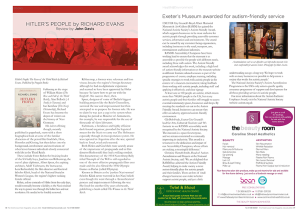
Hitler’s People: The Faces of the Third Reich by Richard Evans. Published by Penguin Books
Following in the steps of William Shirer (The Rise and Fall of the Third Reich), Alan Bullock (A Study in Tyranny) and Ian Kershaw (The Nazi Dictatorship), Richard Evans has become the doyen of writers on the history of Nazi Germany.
His latest offering though, recently published in paperback, starts with a short biographical look at some of the familiar characters of the period like Goebbels, Hess, Himmler and Goring, but then delves into the background, involvement and motivations of other lesser-known individuals closely connected with life in the Third Reich.
These include Ernst Rohm the bruising leader of the SA bully boys, Joachim von Ribbentrop, the out of place diplomat, Albert Speer, the aspiring architect, Adolf Eichmann, the bureaucrat, Leni Riefenshahl, the film director and Gertrud Scholtz-Klink, head of the National Socialist Women’s League, the regime’s highest ranking female official.
Rohm, a close comrade of Hitler from the early days, would eventually become a liability as the Nazis realised the way to power was through the ballot box and not revolution. He needed to be forcibly removed.
Ribbentrop, a former wine salesman and bon viveur, became the regime’s Foreign Secretary although he had no diplomatic experience and seemed to have been appointed by Hitler because ‘he knew how to get on with the English’. No success there, then.
Speer, designer of some of Berlin’s biggest building projects like the Reich Chancellery, survived the war and imprisonment but then attempted to re-purpose his former role. He was to claim he was just a cog in the system when during his period as Minister of Armaments, for example, he was responsible for the use of thousands of slave labourers.
Eichmann, a fastidious and highly efficient desk-bound organiser, provided the logistical means for the Nazis to carry out The Holocaust especially through its transportation system. He was captured in Argentina after the war, spirited back to Israel, tried and executed.
Both Hitler and Goebbels were acutely aware of the importance of propaganda and in film director Riefenstahl they had a willing conduit. Her documentary of the 1934 Nuremberg Rally titled Triumph of the Will is still regarded as one of the most effective propaganda films ever made and she also filmed the 1936 Olympic Games in Berlin (called Olympia).
Known in Britain as the ‘perfect Nazi woman’ Scholtz-Klink never wavered in her Nazi beliefs even though she went through a ‘denazification’ process and imprisonment following the war. She lived for another fifty years afterwards, publishing a book called The Woman in the Third Reich.