

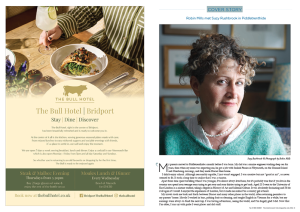
My parents moved to Piddletrenthide a month before I was born. My dad was a marine engineer working deep sea for years, then when my mum was expecting me, he got a job with Sealink Ferries in Weymouth, on the Channel Island and Cherbourg crossings, and they made Dorset their home.
I didn’t enjoy school. Although reasonably capable, I just wasn’t engaged. I was creative but not “good at art”, so never seemed to fit. It took a long time to realise that I was a curator.
Apart from time spent travelling when I was younger, I’ve almost always lived here, but it’s probably true that if you live in the country you spend your teenage years trying to get away and your thirties trying to get back. Aged 23 I went to the University of East London as a mature student, taking a degree in History of Art and Material Culture. It was absolutely fascinating and I’d do it all again if I could. I enjoyed the experience of London, but it made me realise I’m a country girl at heart.
My travels took me back and forth between Dorset and many other places in the world, often returning penniless to my parents’ home. Mostly I worked in bars, picking fruit or cleaning, and taught English in Vietnam for a while, but my earnings were always to fund the next trip. I was having adventures, seeing the world, and I’m hugely glad I did. Now that I’m older, I can say with pride I went places and did stuff.
I moved back to Dorset properly at 28 and finally embarked on a career. After volunteering at the Russell Cotes Art Gallery and Museum in Bournemouth, I got a job at Dorset County Museum, initially as Front of House and Shop Manager. When I left school, and later as a student in London, I worked for Monsoon, so had retail and display experience. The curator at the museum at that time, Judy Lindsay, knew I wanted to get into managing exhibitions and gave me a chance as Temporary Exhibitions Manager; that was my first career job. On the temporary exhibition committee was Vivienne Light, an amazing artist and curator who was a great mentor to me. The job gave me experience of working with many artists, writing their biographies, and understanding what they were trying to achieve – all in the context of Dorset, which is important to what I do now.
I worked at the Museum for 5 years, then was unfortunately made redundant along with most of the curatorial staff. I was expecting my first child at the time, so with the redundancy payment was able to take a year off when my son Mylo was born. I then got a job with Dorset Art Weeks as programme curator, working with Jem Main for almost 10 years, another great mentor. As Art Weeks happens every other year, we would do a separate project in between. In 2017 we produced a publication and big exhibition called Making Dorset, in Wolfeton Riding House, a wonderful 16th C barn in Charminster (the oldest equestrian riding school in England).
Then I got a call from an old colleague who had worked in marketing at the Museum and was now working for the hospital charity. There has been an arts programme at Dorset County Hospital for nearly 40 years and following a hiatus in management she asked if I would come in as a freelancer to get the exhibitions up and running again. I was craving something new and a bit of a challenge, so I said yes. After a year, and in the midst of Covid, I was offered a contract, and I’ve been Arts in Hospital Manager ever since.
It’s never a boring job; there’s something new and different happening all the time. Due to my previous roles, I know quite a lot of Dorset artists, and I also work for Evolver Magazine, which keeps me in the loop. Sometimes I’ll see someone’s work which I think would be great to show in the hospital, but because I’m managed by a steering group consisting of hospital trustees and representatives from different areas of hospital management, I have to propose everything to them first, but it’s a process which works. The artists know the hospital’s not a prime selling space, but that’s not what it’s about; sometimes works do sell though.
The programme I manage is threefold: there’s a curatorial role, there’s design and environment, and there’s participation. I curate the collection and work with the artists on designing interior spaces, but for the participation with patients and staff I bring in a colleague, Caroline Barnes. She goes onto the wards, with volunteers, and does art activities with the patients. The benefit to patients, if measured as return on investment (in what they now call Creative Health rather than Arts in Hospital), is consistently shown to be overwhelmingly worthwhile. For example, I have recently been working with a group called “In Jolly Good Company” who run weekly dementia-friendly sessions for individuals to engage in creative and fun activities. It gives them a new social network and an opportunity to share experiences with people in similar situations, activities which potentially stop them visiting the GP so frequently because of loneliness or isolation. Our mission is to expose people to creative activities while they’re in hospital, in the hope that they’ll continue with them afterwards, which can help patients with their basic needs, such as the use of motor skills and decision-making. We also hope to give them a sense of agency which has often been lost. It’s all about giving people a better quality of life while taking pressure off the NHS. We’re also currently running an outreach programme at the Arts Centre in Dorchester called Art for Memory, for people with early-onset dementia, which offers all the above benefits.
It happens that this week is Creativity and Wellbeing Week, a national celebration of every aspect of Creative Health, and I’ve been lucky enough to have had an article accepted for the Big Issue. I really enjoy writing and I’d like to do more. I always enjoyed writing exhibition interpretation and doing the research; I’ve helped with Evolver for over 7 years, and I contribute to the Sherborne Times. When writing about art, you try and aim it at an educated audience—I try to avoid unintelligible “artspeak”—but written interpretation for art in hospital is an interesting challenge; the audience haven’t made the decision to see this art, which is very different to choosing to visit a gallery. I’m trying to spark an interest in the art that patients, staff and visitors see within hospital, and in doing so perhaps stimulate a welcome distraction from the reason they’re there. It may even be a start in their journey of being interested in art and culture. The work I’m putting in the hospital is work that the community can relate to, most of which also relates to our local environment, landscapes, and seascapes. I like to include archaeology which can be of interest to people like farmers who have worked the land all their lives and always been curious about what has shaped their landscape.
It’s fair to say my job is completely up my street. It’s perfect for all the things I’m interested in. I’ve always loved interior design so I can bring that element into my work, and because I did Material Culture as part of my degree I’m into the history of photography, fashion, and book illustration, and I love that I can bring all of those skills into the job. I’m constantly having ideas about things I want to do, but there’s never enough time, never enough money. I’m always inspired, never stale. I enjoy producing small publications like our Art Map; and of course, I adore working with artists and hanging their exhibitions. There’s so much depth and opportunity in what we do. If I had to go back to any of my previous jobs, I’d just be bored.