



Multidisciplinary artist Arun Sood talks to Fergus Byrne about Shifting Waterscapes, his collaborative exhibition with Ellen Wiles.
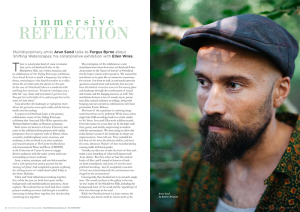
There is a particular kind of sonic resonance that exists at Otterhead Lakes in the Blackdown Hills, says writer, musician and co-collaborator of the Shifting Waterscapes exhibition, Arun Sood. It isn’t so much a frequency, but rather a dense, storied quiet—the kind that settles in a valley where the air holds onto the ghosts of the past. In the case of Otterhead Lakes it is medieval mills and long-lost mansions. ‘It kind of envelopes you a little bit’, says Arun ‘and you kind of get lost in it. You get lost in the light of it, and you get lost in the sense of time there.’
Arun describes the landscape as ‘spring line mire’, where the ground is never quite solid, and the history melds into the ecology.
A response to Otterhead Lakes is the primary collaborative centre of the Shifting Waterscapes exhibition that Arun and Ellen Wiles opened at the Thelma Hulbert Gallery in Honiton in January.
Both artists are lecturers at Exeter University and came to the exhibition from projects with similar perspectives but on opposite ends of Britain. Ellen, a novelist, multidisciplinary artist, musician, and academic, is also involved in an artist residency and research project at The Centre for Resilience in Environmental, Water and Waste (CREWW) at the University of Exeter. It aims to engage diverse audiences with the water system and issues surrounding its future resilience.
Arun, a writer, musician, and arts-led researcher with a soft-spoken but intense passion for the ‘ecology of place’, had completed a project exploring the shifting waters of a tidal island called Vallay in the Outer Hebrides.
‘Ellen and I had talked about working together for a while because we both have quite similar backgrounds and multidisciplinary practices,’ Arun explains. ‘We realised that we both had these similar projects working on water and thought it would be interesting to bring those together, but also develop something new together.’
The centrepiece of the exhibition is a new installation born from their time at Otterhead Lakes. Arun points to the ‘layers of history’ at Otterhead that he hopes visitors will respond to. ‘We wanted the installation to be quite like an immersive experience for visitors. For them to walk in and maybe provoke questions around water and wetlands, but also just have this kind of evocative sense of this watery place and landscape through the combination of sound and visuals, and the hanging canvases as well.’ The installation features a mix of sound, music, poetic text, film, natural sculpture and collage, along with hanging canvases created in collaboration with local printmaker Emma Molony.
The heart of the experience is a moving image work that refuses to be ‘polished.’ While many artists might take field recordings back to a sterile studio to ‘fix’ them, Arun and Ellen took a different path. Over the course of a year, they sat by the lakes with flute, guitar, and ukulele, improvising in tandem with the environment. ‘We were trying to allow this really distinct sound of the landscape to shape our improvisations,’ Arun tells me. They included the fast flow of the river, the delicate trickles, and even the eerie, ultrasonic ‘flickers’ of bats recorded during evening walks with local guides.
‘Initially, my idea was to take the basis of that and… make a nice recording of what we’d improvised,’ Arun admits. ‘But then when we had this kind of banks of files, and I started to listen to it back… we both immediately said, look, it’s not the most polished recording… but it’s completely evocative of how our relationship with the environment was shaped by the environment.’
Consequently, they decided not to re-record a single note. The sound you hear in the gallery is the raw, ‘in situ’ reality of the Blackdown Hills, including the background noise of the wind and the ‘squelching’ of their own footsteps in the mud.
While the Otterhead room is a joint venture, the exhibition also travels north to Arun’s work in the Outer Hebrides. In a section titled Tidal Memory, Arun explores his personal connection to Vallay, a tidal island where his maternal grandmother was one of the last inhabitants.
There are parallels between the two sites that evoke memory and heritage. Just as Otterhead once boasted a lavish 19th-century seat of power, Vallay was home to an Edwardian mansion built by the antiquarian Erskine Beveridge. Arun’s maternal grandmother was his housekeeper and one of the last people to leave the island.
‘The tidal island completely shapes the way people are,’ Arun says, recounting stories of his grandmother hiking up her skirts to trek across the strand after a dance in North Uist—racing against the incoming sea. ‘Their lives are shaped by the water.’
Their deaths are too. Arun relates the story of how, when Erskine Beveridge died, the property was left to his son George, who drowned while trying to get over to Vallay on that same strand. ‘Then it was just left to decay because there was no heir.’
Today, both histories are fading. While the Otterhead mansion has entirely vanished, Vallay’s ruins remain visible, gradually ‘collapsing into the ecology of the island.’
Working on Otterhead offered Arun a different kind of creative freedom compared to the deeply personal Hebridean project. ‘You give up your sense of self a bit more to the kind of broader environment… and the kind of, more than human, and the water,’ he reflects. ‘There’s something quite liberating about that in its own way, where I suppose, personal identity recedes a little bit more.’
It is hard to consider Shifting Waterscapes without acknowledging the looming presence of climate change. The exhibition doesn’t preach, but it does point toward the precarity of our resources.
Arun highlights the remarkable foresight of Erskine Beveridge, who wrote about environmental change and, in the early 20th century, was already measuring the tides by inserting sticks into the layers of peat on Valley. ‘He writes with quite some concern about the climatic future of Vallay,’ Arun says.
In the Otterhead film, Ellen’s voiceover evokes the layers of history—the lawn tennis and medieval milling—before focusing on the ‘precarity of resources’ we face today. It serves as a reminder that water, which we have spent centuries trying to harness, dam, and pipe, remains ultimately a force beyond our control.
As Artist-in-Residence in the CREWW Ellen says she has taken a deep dive into watery ecologies, and is ‘passionate about the power of the arts to engage audiences in vital environmental science research and prompt new forms of awareness and action.’ She says that she and Arun both wanted the work in this new exhibition to ‘highlight the importance of waterscapes for environmental resilience, and to prompt audiences to reflect on the preciousness of our watery ecosystems at a time of growing global scarcity of freshwater and biodiversity collapse.’ But rather than confronting audiences with the risks, she says they ‘first wanted to draw people into the experiential wonderment of waterscapes, including their acoustic ecologies, and their power to improve wellbeing as well as ecosystem health.’
‘With Otterhead Lakes, you’ve got this history of deep ecological time,’ Arun concludes. ‘But then you’ve got this cultural history, where it’s used as a resource… from a medieval mill to a 19th-century lavish mansion with lavish gardens.’
Today, there are no longer humans inhabiting these specific spots. There are only beavers, spring lines, and the shifting silt. Shifting Waterscapes offers a meditative look at what remains when the mansions fall and the water takes back the land.
Shifting Waterscapes is open until February 28. Tuesday to Saturday, 10 to 5. Thelma Hulbert Gallery, Dowell St, Honiton EX14 1LX. thelmahulbert.com / 01404 45006. Free admission.